Choosing the right diamond tooling can make the difference between an efficient floor preparation project and hours spent fighting slow cutting, deep scratches or inconsistent polishing results. The machine matters, but the bond, grit, tooling type and progression used on the floor are equally important.
Lavina diamond tools cover the full floor restoration process, from aggressive concrete grinding and coating removal through to scratch refinement, resin polishing and ongoing commercial floor maintenance. However, not every diamond is suitable for every surface or stage of the job.
The correct choice depends on the hardness of the concrete, the required aggregate exposure, whether the floor will be processed wet or dry, the machine being used and the final level of gloss or clarity required.
This guide explains how to choose between metal bond diamonds, ceramic and copper transition tools, resin polishing pads, edge pads and SupraShine maintenance pads for concrete, terrazzo and natural stone floors.
What Are Lavina Diamond Tools Used For?
Lavina diamond tools are professional floor preparation and polishing tools designed for concrete grinding, coating removal, aggregate exposure, scratch refinement, concrete polishing, terrazzo restoration, stone care and commercial floor maintenance.
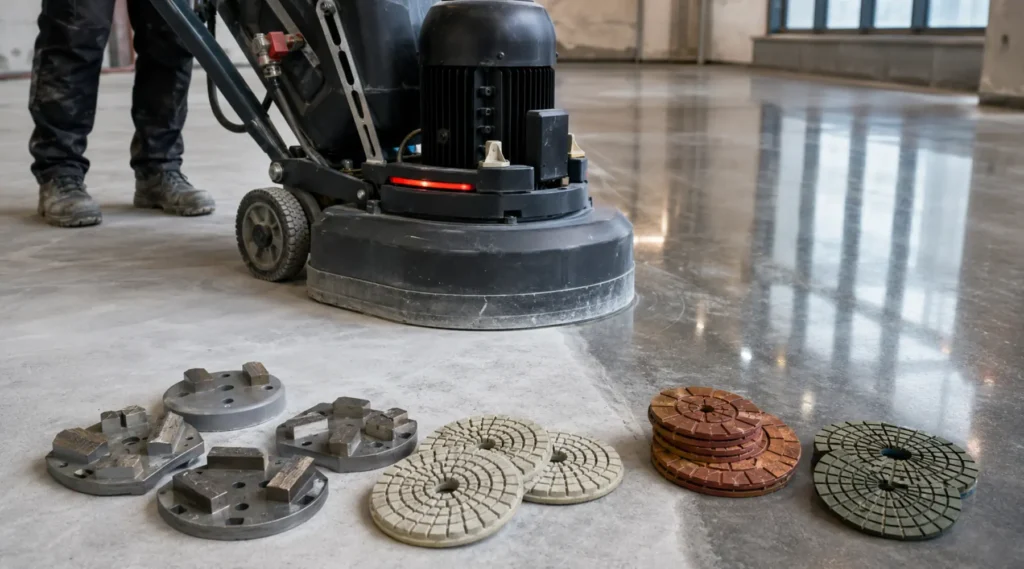
Different tools are used at different stages of the process. Metal bond diamonds perform the initial cutting and grinding. Transition tools remove the scratches left by the metal stages. Resin pads progressively refine and polish the floor, while maintenance pads help preserve or restore its appearance after the main polishing work has been completed.
The available Lavina diamond tools include metal bond diamonds, Razor Ceramic edge pads, Corsa Hybrids, heavy-duty copper pads, resin polishing pads, NATO pads and SupraShine diamond maintenance pads.
Start by Testing the Concrete Hardness
Concrete hardness should be assessed before selecting a metal bond diamond. Using the wrong bond can reduce cutting performance, cause the tool to glaze or make the diamonds wear much faster than expected.
The general rule is:
Hard concrete requires a softer bond, while soft concrete requires a harder bond.
On hard concrete, a softer metal matrix gradually wears away and exposes fresh diamond particles. If the bond is too hard for the floor, it may not release new diamonds quickly enough, causing the tool to glaze and stop cutting efficiently.
Soft or abrasive concrete has the opposite effect. It can wear a soft bond too quickly, reducing the working life of the tool. A harder bond helps retain the diamonds for longer and provides more controlled wear.
For this reason, contractors should avoid choosing tooling based only on the appearance or age of a slab. Testing the surface first provides a more reliable basis for selecting the correct bond.
Choosing the Correct Metal Bond Diamond
Metal bond diamonds are normally used during the first stages of concrete grinding. Depending on the grit and tooling selected, they can remove surface contamination, flatten uneven areas, expose aggregate and establish the scratch pattern that will be refined during later stages.
AK Surface Solutions provides three principal bonds for different concrete hardness levels.
Red Bond for Hard Concrete
The Metal Bond Red is a soft-bond diamond designed for hard, dense concrete. Its bond is formulated to wear at a controlled rate so that fresh diamonds remain exposed while grinding.
It is a suitable choice when harder concrete causes standard or harder-bond tools to glaze, skid across the surface or cut too slowly.
Grey Bond for Medium Concrete
The Metal Bond Grey is intended for medium concrete. It provides a balance between cutting performance and controlled tool wear, making it a practical option for many general concrete grinding projects.
Yellow Bond for Soft Concrete
The Metal Bond Yellow uses a harder bond designed for soft or abrasive concrete. The stronger bond helps prevent the diamond segment from wearing too quickly while maintaining controlled grinding performance.
Selecting the correct bond is only the first decision. Contractors must also choose the starting grit according to the condition of the slab and the required finish.
Which Metal Bond Grit Should You Start With?
The starting grit determines how deeply the floor will be cut and how much aggregate will be exposed. Starting too aggressively can remove more material than required and create a deeper scratch pattern. Starting too fine may not cut efficiently enough to achieve the desired result.
For a fully exposed aggregate finish, a typical progression is:
30 grit → 70 grit → 120 grit metal bond
The 30-grit stage opens the slab and performs the initial material removal. The 70-grit stage refines the deeper scratch pattern, while the 120-grit metal bond prepares the surface for transition tooling.
For small to medium aggregate exposure, contractors may be able to begin with a 70-grit tool, depending on the slab and the condition of the surface.
For a salt and pepper finish, many contractors start with a 120-grit metal bond. This lightly cuts the surface and reveals fine aggregate without removing enough concrete to create a heavily exposed finish.
These progressions provide a useful starting point, but every floor should be assessed individually. Coatings, surface damage, slab hardness, machine weight and the required final appearance can all affect the tooling sequence.
Single-Segment or Double-Segment Metal Tools?
Segment configuration affects the contact pressure and aggressiveness of the tool.
Single-segment tooling generally creates greater pressure at each segment, which can produce a more aggressive cut. It is commonly selected for lighter grinding machines or projects where faster material removal is required.
Double-segment tooling distributes the machine weight across a larger contact area. It can provide a more stable and controlled grinding action and is often used with heavier machines.
The most appropriate option depends on the machine, the condition of the floor and how aggressively the surface needs to be cut. If you are unsure, contact AK Surface Solutions with details of your machine and floor before ordering.
Why Transition Tools Are Important
A floor can appear evenly ground after the final metal bond stage while still containing scratches that will become increasingly visible as the gloss develops. Moving directly from metal bond diamonds to fine resin pads may leave these scratches in the floor.
Transition tools bridge the gap between aggressive metal grinding and resin polishing. Their job is to remove or reduce the metal scratch pattern without creating another pattern that is equally difficult to refine.
An effective transition stage can improve clarity, reduce the number of corrective passes required and help produce a more consistent polished finish.
Wet Transitioning with Heavy Duty Copper Pads
Heavy Duty Copper Pads are designed to remove scratches after the metal grinding stages and prepare the floor for resin refinement.
Copper pads should be used wet. Water cools the tooling, supports the intended cutting action and helps manage the slurry generated during the process.
These pads are particularly useful after a 120-grit metal bond stage when the contractor needs to refine the remaining scratches before moving into heavy-duty resin pads.
The floor should be inspected carefully after each transition stage. Continuing to finer grits before the previous scratches have been removed will not solve the underlying problem. Fine polishing can make those scratches more visible.
Dry Transitioning with Corsa Hybrids
For contractors following a dry process, Corsa Hybrids provide an alternative transition between metal bond diamonds and resin polishing pads.
Hybrid tooling combines aggressive scratch-removal ability with a smoother finishing action than conventional metal tools. It helps reduce the metal scratch pattern and prepares the surface for the resin stages without requiring a wet copper transition.
The choice between copper pads and ceramic hybrids should therefore be based partly on whether the project is being processed wet or dry.
Razor Ceramic Pads for Edges and Detailed Areas
Large planetary grinders cannot process every part of a floor. Edges, corners, doorways and areas around fixed features usually require smaller tools that can reproduce the main floor’s scratch progression as closely as possible.
Razor Ceramic Pads in 100mm and Razor Ceramic Pads in 125mm are designed for edge grinding and surface refinement in areas that larger tooling cannot reach.
Their flexible construction helps maintain surface contact and supports quicker scratch removal around the perimeter of a room. They work particularly well with higher-speed hand tools when used at the correct operating speed.
Edges should not be treated as a separate cosmetic task at the end of the project. They should follow a progression compatible with the main floor. Otherwise, differences in scratch refinement, aggregate exposure or gloss may create a visible border around the finished area.
Refining the Floor with Heavy Duty Resin Pads
Once the metal scratches have been removed through a copper or hybrid transition, the floor can move into the resin polishing stages.
Heavy Duty Resin Pads continue refining the surface and remove the scratches left by the transition tools. They are commonly used through the lower and middle polishing stages, often from approximately 100 to 400 grit depending on the floor and the preceding tooling.
Each stage should remove the scratches produced by the previous grit. Skipping stages can sometimes save time on a very well-prepared floor, but it can also leave a mixed scratch pattern that reduces clarity and reflectivity.
Before progressing, clean the surface thoroughly and inspect it under suitable lighting. Dust or slurry from a previous grit can contaminate the next stage and introduce deeper scratches back into the floor.
Building Gloss with NATO Polishing Pads
After the heavy-duty resin stages have established a smooth and evenly refined surface, NATO Polishing Pads can be used to develop greater gloss, clarity and reflectivity.
These finishing stages do not compensate for poor preparation. A premium polished finish begins with correct metal grinding and complete scratch removal during the transition and lower resin stages.
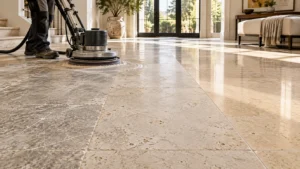
When the early stages have been completed properly, NATO pads can help produce a cleaner, sharper reflection on polished concrete, terrazzo and suitable stone floors.
The required stopping grit should be determined by the specification of the project. Some commercial environments require a practical satin or semi-polished finish, while decorative floors may be taken through a finer progression to achieve higher reflectivity.
Using SupraShine Pads for Commercial Floor Maintenance
A polished floor still needs an appropriate maintenance system. Dirt, foot traffic, cleaning residues and unsuitable chemicals can gradually reduce its clarity and appearance.
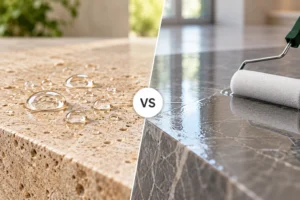
SupraShine High Performance Pads are diamond-impregnated floor pads designed to clean and mechanically enhance hard floors during routine maintenance. They can be used with scrubber dryers and work with water, reducing reliance on chemical cleaning products.
They are suitable for maintaining polished concrete, terrazzo, natural stone and several other hard floor surfaces. Different grits can support deep cleaning, surface improvement, gloss enhancement or routine daily maintenance.
SupraShine pads are particularly useful in supermarkets, airports, hospitals, warehouses and other commercial environments where a large floor area must be maintained efficiently.
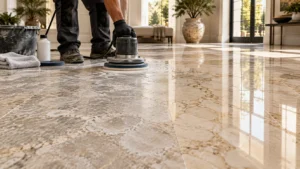
They can also support restoration work on stone floors by helping with cleaning, light scratch improvement, honing and gloss maintenance. However, the floor condition should be assessed before choosing the starting grit. A lightly dulled surface does not require the same treatment as a heavily scratched or uneven floor.
Polishing Stone Floors with Lippage
Stone floors with lippage can be challenging to polish consistently. Raised edges may receive more contact from conventional floor pads than the lower sections of each tile. This can lead to picture framing, where the edges of the tile appear different from the centre.
Flexible High Performance and Heavy Duty pads can improve contact across an uneven stone surface. This helps contractors refine and polish the floor more consistently while reducing the risk of an obvious picture-frame effect.
Severe lippage may still require mechanical flattening before polishing. Maintenance pads should not be expected to correct substantial height differences between tiles.
For broader guidance on professional stone restoration, see the Stone Honing and Polishing Guide.
A Typical Lavina Tooling Progression
There is no universal progression for every floor, but a typical polished concrete process may include:
Metal grinding: Select Red, Grey or Yellow bond according to the concrete hardness, then use the appropriate starting grit for the required aggregate exposure.
Transition: Use Heavy Duty Copper Pads for wet processing or Corsa Hybrids for a dry transition.
Resin refinement: Progress through Heavy Duty Resin Pads until the metal and transition scratches have been removed and the surface is evenly refined.
Final polishing: Use NATO Polishing Pads to build the specified level of gloss, clarity and reflectivity.
Ongoing maintenance: Use the appropriate SupraShine pad with a scrubber dryer or compatible floor machine to maintain cleanliness and surface appearance.
This sequence should be adjusted to suit the slab, machine, floor condition and desired finish.
Common Diamond Tooling Mistakes
One of the most common mistakes is selecting a metal bond without testing the concrete. This can cause glazing on hard floors or rapid tool wear on soft concrete.
Another is moving to the next grit before the previous scratch pattern has been fully removed. A floor may become shinier as polishing continues, but the remaining deep scratches will usually become more noticeable rather than disappear.
Poor edge integration can also affect the final result. If the perimeter is processed differently from the main floor, it may show a different level of exposure, texture or gloss.
Finally, contractors should avoid treating maintenance pads as a substitute for full restoration. SupraShine pads can deliver excellent cleaning, polishing and surface-improvement results, but a severely damaged, uneven or deeply scratched floor may require grinding and a structured restoration process first.
Need Help Choosing the Correct Lavina Diamond Tools?
The right progression depends on more than the name of the floor material. Concrete hardness, machine weight, segment configuration, existing coatings, aggregate exposure and wet or dry processing all influence the choice.
Browse the complete range of Lavina diamond tools for grinding and polishing, or contact AK Surface Solutions for advice before ordering.
Providing details of your floor, machine, current condition and required finish will help the team recommend a more suitable starting tool and progression.
Frequently Asked Questions
What are Lavina diamond tools used for?
Lavina diamond tools are used for concrete grinding, floor preparation, coating removal, aggregate exposure, scratch refinement, concrete polishing, terrazzo restoration, stone floor care and commercial floor maintenance.
Which bond should I use for hard concrete?
Hard concrete generally requires a softer metal bond. The softer bond wears at a controlled rate and continues exposing fresh diamonds so that the tool can cut dense concrete effectively.
Which bond should I use for soft concrete?
Soft or abrasive concrete normally requires a harder bond. This helps prevent the diamond segment from wearing too quickly.
What grit should I use for fully exposed concrete?
A common progression for fully exposed concrete is 30, 70 and 120 grit metal bond before moving into transition and resin tooling. The actual starting grit should be selected according to the slab and the amount of aggregate exposure required.
What grit should I use for a salt and pepper finish?
Many contractors start with a 120-grit metal bond for a salt and pepper finish. This lightly exposes the surface without cutting as deeply as a coarse metal tool.
Can I move directly from metal bond diamonds to resin pads?
It is possible on some floors and with certain tooling systems, but using a suitable transition tool usually improves scratch removal. Copper pads or ceramic hybrids can help bridge the gap between the final metal stage and resin polishing.
Should copper diamond pads be used wet or dry?
Heavy Duty Copper Pads should be used wet. For dry transition work, Corsa Hybrids provide a more appropriate option.
What are SupraShine pads best for?
SupraShine pads are designed for commercial hard-floor cleaning, polishing and maintenance using water. They are suitable for scrubber dryers and can be used on polished concrete, terrazzo, stone and other compatible hard floors.
Can SupraShine pads restore a damaged floor?
They can improve cleaning, light scratches, dullness and gloss, depending on the selected grit and condition of the floor. Deep scratches, severe lippage or significant surface damage may require a complete grinding and polishing process.
How do I know when to move to the next grit?
Clean the floor and inspect it under good lighting. Move to the next grit only when the scratch pattern from the previous stage has been removed consistently across the floor, including the edges.