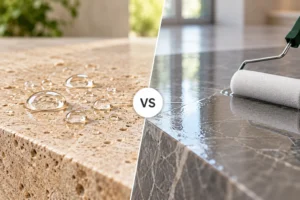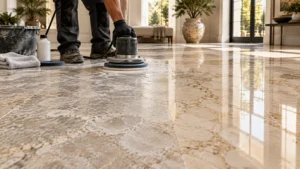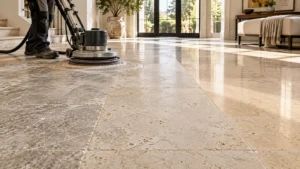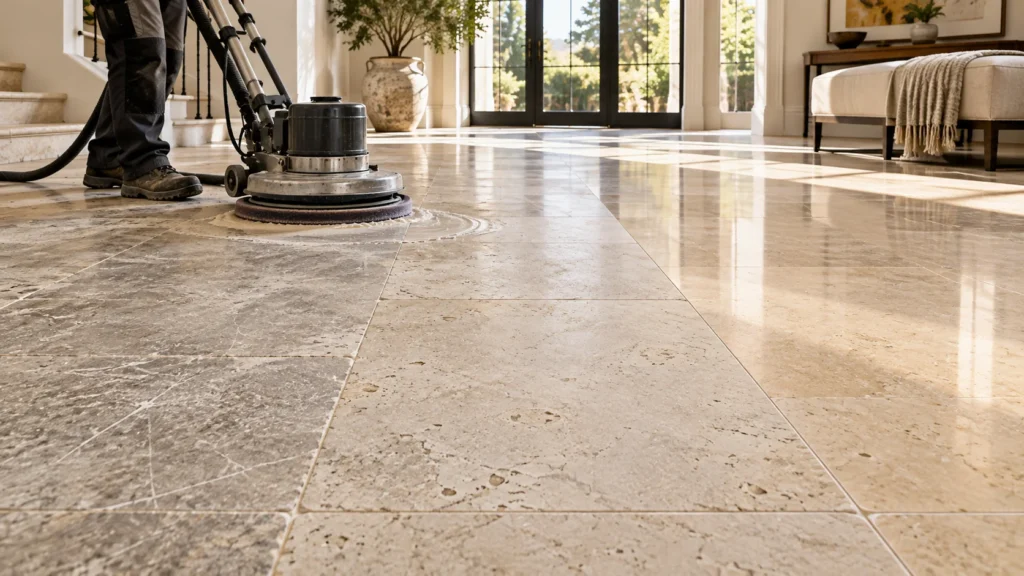
A dull limestone floor does not automatically need to be completely ground and repolished. In some cases, the loss of appearance is caused mainly by ingrained dirt, cleaning residue or an unsuitable maintenance product, and a thorough professional clean may reveal that the original finish is still in reasonable condition. In other cases, the surface itself has become scratched, etched or worn, which means cleaning alone will never restore an even finish.
The correct restoration method therefore depends on what has actually caused the limestone to look dull. A lightly soiled honed floor may need cleaning and protection, while a polished limestone floor with traffic wear may require honing followed by polishing. Floors affected by scratches, acidic cleaning products, uneven wear or previous coatings can require a more involved restoration process before any final protection treatment is applied.
For UK stone restoration contractors, cleaners and property managers, the most reliable approach is to assess the stone first and build the process around its current condition. This guide explains how to decide whether a dull limestone floor needs cleaning, honing, polishing or sealing, and how those stages work together to produce a consistent result.
Why do limestone floors become dull?
Limestone can lose its appearance for several different reasons, and identifying the cause is important before choosing a restoration product. Dirt carried indoors on footwear can act as a fine abrasive over time, particularly in entrance areas, corridors and other high-traffic sections. This gradually reduces the clarity of a polished surface and can also make a honed floor look uneven or tired.
Cleaning methods can also affect the finish. Repeated use of unsuitable detergents may leave residue behind, while excessively aggressive pads can create fine scratches. Limestone is also sensitive to acidic products because it is a calcium-based natural stone. Bathroom descalers, vinegar-based cleaners and other acidic chemicals can attack the surface and create dull or etched areas that cannot simply be washed away.
Wear is another major factor. A floor may remain relatively untouched beneath furniture and close to walls while the main walking routes become visibly flatter, scratched or less reflective. When this happens, the problem is within the surface itself rather than simply sitting on top of it.
Previous treatments can complicate the picture further. Old waxes, topical coatings, poorly applied sealers and years of maintenance products can create patchy shine or dark areas that make the limestone appear damaged when part of the problem is actually surface build-up. A proper assessment should therefore take place before assuming the floor needs aggressive honing.
Start by identifying the existing limestone finish
Before trying to restore shine, establish what finish the limestone was intended to have. Limestone floors can be installed with polished, honed, satin, brushed, tumbled or more textured finishes, and not every dull-looking floor is supposed to be glossy.
A polished limestone floor has a smoother, more reflective surface and will normally show light reflections relatively clearly when it is in good condition. A honed limestone finish is deliberately softer and more matt, with less reflection. Trying to make a honed floor highly glossy simply because it appears dull may change the intended appearance rather than restore it.
Look at protected areas where the floor has received less traffic. Sections beneath furniture, inside cupboards or close to skirting can sometimes reveal the original finish more clearly than the middle of the room. Comparing these areas with the worn sections can help establish how much the appearance has changed.
The colour and type of limestone also influence how obvious wear becomes. Darker and more compact stones may show changes in reflection very clearly, whereas a lighter limestone with a naturally open structure may have a softer appearance even after professional restoration. This is why a small test area is essential before committing to a process across the complete floor.
Is the limestone dirty or physically worn?
One of the most useful decisions during assessment is whether the dullness comes mainly from contamination or from physical damage. A floor covered with detergent residue, grease and ingrained dirt may look flat even though the stone underneath still has a relatively consistent finish.
Cleaning a representative area can quickly reveal whether this is the case. Once the dirt and residue have been removed and the section has dried, compare it with the untreated floor. If the colour, clarity and consistency improve significantly, restoration may require less abrasive work than initially expected.
If the cleaned area remains dull and scratches are clearly visible under reflected light, the finish itself has probably been worn. Similarly, if there are cloudy patches that remain after cleaning, the surface may have been etched by an acidic substance. These problems require honing or polishing rather than simply stronger cleaning.
Avoid escalating to increasingly aggressive chemicals when ordinary cleaning does not restore the appearance. If the limestone itself has been damaged, stronger chemistry can make the situation worse, particularly when acidic products are involved.
Clean the limestone thoroughly before honing
Professional restoration should begin with a clean surface. Grease, wax, soil, detergent residue and old maintenance products can interfere with abrasive pads and make it difficult to judge the true condition of the limestone.
The cleaning method should be selected according to both the contamination and the stone. A suitable neutral cleaner may be enough for routine residue, while heavier grease or old coatings may require a more specialist alkaline cleaning or stripping process. The objective is to remove unwanted material without introducing additional damage to the limestone underneath.
Mechanical agitation can improve cleaning, but the pad or brush must be suitable for the finish. A highly aggressive floor pad used on polished limestone can create scratching that was not present before cleaning started. The surface should also remain wet for the required working period rather than allowing dirty cleaning solution to dry back onto the floor.
After cleaning, extract the contaminated solution thoroughly and rinse where necessary. Allow the floor to dry sufficiently before assessing it again. Limestone can look darker and richer while wet, so deciding whether the floor has been successfully restored while moisture remains on the surface can be misleading.
When cleaning alone may be enough
Not every dull limestone floor needs honing. If the stone has a consistent surface with no significant scratches, etching or traffic wear, and the apparent dullness was largely caused by surface contamination, professional cleaning may restore a satisfactory appearance.
This is particularly relevant to honed limestone. Because the intended finish is matt or low sheen, contractors should avoid introducing unnecessary polishing simply to make the floor look more dramatic. A properly cleaned honed floor can have a refined, uniform appearance without a strong reflection.
The same principle applies where an old maintenance product has created haze or uneven shine. Once that material has been stripped correctly, the underlying finish may require only minor refinement before protection.
A test area should determine the next step. If cleaning produces the desired result, additional abrasive work only increases labour and removes stone unnecessarily. If scratches, etching or inconsistent wear remain visible, the floor needs to move into a restoration stage.
When does a limestone floor need honing?
Honing is required when physical damage or uneven wear needs to be removed from the upper surface. Rather than attempting to hide scratches or etching with polish or coating, honing mechanically refines the limestone until the affected layer has been reduced sufficiently.
Fine scratches, traffic lanes, light etching and uneven shine are common reasons for honing a limestone floor. More heavily damaged surfaces may require several abrasive stages, while a floor with only minor wear may be restored using a much finer starting point.
The first abrasive should be chosen according to the deepest defect that actually needs removing. Starting too aggressively creates a deep new scratch pattern that then has to be removed through additional stages. Beginning too fine can be equally inefficient because the abrasive may run over the damaged surface without cutting deeply enough to correct it.
Professional limestone restoration is therefore not about automatically completing every available grit. It is about identifying the condition, selecting an appropriate starting point and progressing only as far as necessary to achieve the required finish.
How to hone a dull limestone floor
Once the correct starting abrasive has been selected, work the floor systematically and keep the treatment consistent across each section. The objective of the first honing stage is to remove the relevant defects and establish an even scratch pattern.
After that stage, remove the slurry completely and inspect the limestone before moving on. The next abrasive should refine the scratches created by the previous one rather than simply adding another pattern over the top. This process continues through the required stages until the floor reaches the level of refinement needed for the final finish.
Cleaning between stages is essential. Coarse abrasive particles left behind can become trapped beneath a finer pad and create random scratches that are much deeper than the finish being produced. These marks often become more obvious later when the floor begins to develop greater clarity.
Edges and corners also need attention during the same sequence. One of the most visible signs of incomplete restoration is a floor where the centre looks evenly refined but a darker or duller strip remains around the perimeter. Handheld tools or suitable edge-polishing systems are often needed to keep these areas consistent with the main floor.
AK Surface Solutions’ Stone Honing and Polishing Guide can be used as the main supporting internal resource for selecting the restoration stages and understanding how honing differs from final polishing.
Should limestone be polished after honing?
That depends on the required finish. If the floor is intended to remain honed, the restoration process should stop at the abrasive stage that produces the required matt or satin appearance. Polishing beyond that point would change the character of the surface.
If the original limestone was polished and the goal is to restore gloss, polishing follows after the honing stages have created a sufficiently even and refined surface. The polishing product then develops clarity, depth and reflection rather than being expected to remove scratches left behind from aggressive abrasives.
This distinction is important because polishing cannot compensate for inadequate preparation. If scratches remain visible before polishing begins, they may become even more noticeable as the surrounding surface develops greater reflection. The correct solution is normally to return to the abrasive stage capable of removing those scratches rather than continuing to polish.
A test section should confirm that the selected polishing process produces the required finish on the particular limestone. Natural stone varies considerably, so a product or technique that works well on one floor should not automatically be assumed to produce an identical result on another.
Restoring polished limestone
Polished limestone requires particularly consistent preparation because reflected light makes surface defects easy to see. Scratches, unrefined edges and changes in gloss can become much more obvious once the floor starts to develop a high level of reflection.
After honing has removed the damage, the surface should be refined through the necessary intermediate stages before a limestone-compatible polishing treatment is introduced. The polishing process is then worked in controlled areas so the product can be kept active and distributed evenly.
The surface must be cleaned properly after polishing. Residue left behind can create haze, and allowing polishing slurry to dry may result in marks that require further work. Once the floor is clean and dry, inspect it from several angles rather than judging it only from directly above.
Professional polishing powders and compatible treatments are available through AK Surface Solutions’ Honing and Polishing range. The appropriate product should be chosen according to the stone, existing finish and result of the test area rather than relying solely on the product name.
What if the limestone has been etched?
Etching is common on limestone because acidic substances react with the calcium carbonate within the stone. The result is usually a dull or pale patch where the original surface has been chemically altered.
Light etching may sometimes be corrected as part of the normal refinement and polishing process. Deeper marks require more abrasive work because the damaged layer needs to be removed before the finish can be rebuilt.
The important point is that etching is not ordinary dirt. Applying a stronger cleaner will not restore the original polish, and using an acidic product such as vinegar can enlarge the affected area. This is especially relevant in bathrooms and kitchens, where household descalers or acidic cleaning products may be responsible for the damage in the first place.
When several areas of the floor have been etched, it is usually better to assess the room as a complete restoration project instead of treating every patch independently. Localised spot polishing can create visible differences in gloss if the surrounding floor has also experienced general wear.
What if the limestone is badly scratched?
The depth of scratching determines how much honing will be required. Fine surface scratching from normal traffic may be removed using relatively fine abrasives, while deeper marks may require the restoration sequence to begin much earlier.
Do not automatically chase every extremely deep scratch if doing so would require excessive removal of the surrounding stone. On older limestone floors, a contractor and client may decide that reducing the appearance of a deep isolated mark is preferable to aggressively grinding a large area simply to achieve complete removal.
This is another reason the expected outcome should be agreed before work begins. Restoration can substantially improve worn limestone, but the appropriate degree of intervention depends on the stone, floor thickness, condition, historic character and client’s expectations.
A test area provides a realistic demonstration of what can be achieved and allows the abrasive sequence to be adjusted before the complete floor is treated.
Does dull limestone need sealing after restoration?
Many limestone floors benefit from a suitable impregnating protection treatment once cleaning, honing or polishing has been completed. Limestone is naturally porous to varying degrees, so a compatible sealer can help reduce the penetration of water and staining contaminants.
Sealing should only be carried out once polishing slurry, detergent residue and contamination have been removed and the stone is sufficiently dry. Applying sealer over moisture or residue can create uneven absorption and may leave visible marks.
The selected protection should also match the finish. A homeowner who wants the restored limestone to retain its natural appearance may prefer an impregnating treatment that does not intentionally alter the colour. Other projects may require additional stain protection or a colour-enhancing effect.
AK Surface Solutions’ Stone Protection Guide explains the company’s current approach to selecting protection according to the material, absorbency and desired appearance. AK currently recommends identifying the density and finish of the stone and completing a test before treating the complete surface.
Honed limestone vs polished limestone
A successful restoration does not always mean producing maximum shine. Honed and polished limestone are both legitimate finishes, and the correct result depends on the original specification and the way the space is used.
Honed limestone has a smoother matt or satin appearance that can work particularly well where a softer natural finish is preferred. Minor day-to-day wear may also be less visually obvious because the surface does not rely on high reflection.
Polished limestone produces greater colour depth and reflection, but this also means scratching, etching and wear can become more visible. High-traffic areas therefore require appropriate maintenance if the polished appearance is to remain consistent.
Before restoration begins, confirm whether the objective is to return the limestone to its original finish or intentionally change it. That decision affects the abrasive sequence, polishing stage and final protection treatment.
Common mistakes when restoring limestone floors
One of the biggest mistakes is assuming dull limestone simply needs a polishing product. If the floor is dirty, heavily scratched or etched, polishing cannot correct the underlying cause. The result may be a surface with more shine but the same visible defects.
Another mistake is using acidic cleaners to remove mineral deposits or stubborn dirt. Limestone is acid sensitive, and an aggressive chemical can convert a cleaning problem into a restoration problem by etching the stone. AK’s current cleaning guidance specifically warns that acidic products can etch limestone and other calcite-based materials.
Skipping abrasive stages can also leave visible scratches beneath the final polish. Each honing stage needs to remove the scratch pattern from the stage before it. Moving ahead too quickly may save time initially but often creates additional corrective work later.
Finally, contractors should avoid sealing the floor before it is genuinely ready. Moisture, slurry and cleaning residue need to be removed first, and the chosen protector should be tested so its absorption and final appearance are understood before treating the entire installation.
How to maintain limestone after restoration
Correct maintenance can considerably slow the return of dull traffic areas. Regular removal of dry abrasive soil is important because sand and grit carried indoors on footwear can gradually scratch the finish under repeated traffic.
Routine washing should use a cleaner compatible with natural stone and the particular finish. Avoid automatically selecting the strongest available chemical. A maintenance product should remove the expected contamination without leaving heavy detergent residue or attacking the limestone.
Entrance matting can also make a meaningful difference in commercial buildings and busy homes because it reduces the amount of abrasive debris reaching the floor. Mats need to be maintained properly themselves so that accumulated grit is not continually transferred back onto the limestone.
Where a protection treatment has been applied, monitor the floor over time rather than simply resealing to a fixed calendar. Traffic, cleaning methods, porosity and the type of treatment all influence how quickly protection is depleted.
Can a dull limestone floor be restored without replacing it?
In many cases, yes. One of the advantages of natural stone is that the upper surface can often be mechanically refined when wear is limited to the finish rather than involving serious structural failure.
A floor that looks heavily worn may respond very well once old treatments have been removed, scratches have been honed out and the correct finish has been rebuilt. This can preserve an existing limestone installation that might otherwise appear ready for replacement.
However, restoration is not a solution for every problem. Loose tiles, major cracks, persistent moisture problems, severe movement or badly failed substrates need to be investigated separately. Polishing the surface will not correct problems originating beneath the stone.
Professional assessment is especially valuable on older or high-value installations where unnecessary grinding could permanently change the appearance or character of the material.
Dull limestone floor restoration FAQs
Can you polish dull limestone without honing it first?
Sometimes. If the limestone is already smooth, free from meaningful scratches and has simply lost a small amount of gloss, cleaning followed by a controlled polishing test may be sufficient. If the surface is scratched, etched or unevenly worn, honing will normally be required before polishing.
Can a limestone floor be restored to a matt finish?
Yes. Limestone does not have to be highly polished. A controlled honing process can create or restore a matt or satin appearance, and the abrasive sequence should stop once the required finish has been achieved.
Why does my limestone floor look dull after cleaning?
The floor may have surface residue, or the limestone itself may be worn or etched. Acidic cleaners can also cause permanent dull areas on limestone. Clean and dry a test section before deciding whether the problem requires further cleaning or mechanical restoration.
Can scratches be polished out of limestone?
Very fine surface marks may improve during a light refinement process, but visible scratches usually need to be honed out before final polishing. Polishing products should not be expected to remove deep damage.
Should limestone be sealed after polishing?
Many limestone floors benefit from suitable protection, particularly where the stone is absorbent or exposed to staining. The correct treatment depends on the porosity, finish, location and required appearance of the stone.
How often should limestone floors be repolished?
There is no universal schedule. Traffic levels, maintenance practices, entrance matting, stone type and the original finish all influence how quickly a floor loses its appearance. Restoration should be based on the condition of the surface rather than automatically carried out after a fixed number of months or years.
Restore the limestone according to its condition
Restoring a dull limestone floor should begin with diagnosis rather than immediately reaching for a polishing product. The floor may simply need accumulated contamination removed, or it may have scratches, etching and traffic wear that require progressive honing before the final finish can be recreated.
Clean the surface first, allow it to dry and assess what remains. If physical damage is present, select the least aggressive honing stage capable of correcting it and refine the floor progressively. Polish only when a polished finish is actually required, and apply a suitable protection system once the restored limestone is clean, residue-free and sufficiently dry.
This condition-led approach avoids removing more stone than necessary while producing a more consistent result. It also helps contractors choose products according to the problem they are solving rather than assuming the same process applies to every limestone floor.
AK Surface Solutions supplies professional cleaning, honing, polishing and stone protection products for restoration contractors and surface-care professionals across the UK. For difficult floors, unusual limestone or projects where the correct starting abrasive or protection system is unclear, contact AK Surface Solutions with photographs, details of the existing finish and the result you need to achieve.