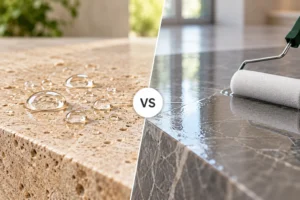
Etch marks are one of the most common causes of dull patches on polished marble, but they are also one of the easiest surface problems to misdiagnose. A pale ring left by a glass, a cloudy patch beside a bathroom tap or a dull area on a marble worktop may look like a stain, yet cleaning it repeatedly often makes no difference. In many cases, the mark is not contamination sitting on the marble at all. The surface of the stone itself has been chemically altered.
This is why removing an etch mark requires a different approach from removing a stain. Light etching may sometimes be corrected with a suitable marble polishing process, while deeper damage usually needs to be refined or honed before the original finish can be restored. Applying stronger cleaners, household acids or increasingly aggressive chemicals can deepen the damage rather than remove it.
For stone restorers, professional cleaners and homeowners dealing with high-value marble, the safest approach is to identify the problem first, determine how deeply the surface has been affected and then use the least aggressive restoration process capable of producing an even finish.
What is a marble etch mark?
A marble etch mark is surface damage caused by a chemical reaction between an acidic substance and the calcium carbonate within the stone. Marble, limestone and travertine are all calcium-rich materials, which means they can react with acids found in food, drinks, household cleaning products and specialist chemicals.
When an acidic substance contacts polished marble, it can begin reacting with the surface almost immediately. This reaction alters the smooth polished layer and creates microscopic irregularities that scatter light instead of reflecting it evenly. The affected area therefore appears dull, pale, cloudy or matt compared with the surrounding polished stone.
Because the damage is within the marble surface, ordinary cleaning does not remove it. Even when every trace of the original spill has been cleaned away, the change in finish remains. Restoring the marble means refining or repolishing this damaged surface rather than continuing to clean it.
The severity can range from a very light loss of gloss to a visibly rough area that requires several abrasive stages before it can match the surrounding marble again.
What causes marble to become etched?
Everyday acidic substances are responsible for a large proportion of marble etching. In kitchens, common causes include lemon juice, lime juice, vinegar, wine, fizzy drinks, fruit juices and some food products. Even a relatively brief spill can affect highly polished marble if it is not removed quickly.
Bathrooms create a different risk. Many conventional limescale removers, toilet cleaners and descaling products contain acids because these ingredients are effective at dissolving mineral deposits. Unfortunately, a product designed to remove limescale from ceramic or glass may also attack marble, limestone or travertine.
Cleaning mistakes can create much larger areas of etching than an accidental food spill. Using an acidic floor cleaner across an entire marble floor can reduce gloss over a wide area, while repeatedly applying unsuitable products can gradually create an uneven or cloudy finish.
Contractors should therefore ask what happened before the mark appeared. Understanding whether the damage came from a single spill, an incorrect cleaning chemical or long-term maintenance can help determine whether the problem is localised or present across a much larger area.
Is it an etch mark or a stain?
Before trying to remove anything, establish whether you are dealing with etching, staining or both. These problems can appear similar at first glance but require very different treatments.
A stain usually involves a substance penetrating into the pores of the stone and causing discolouration. Oil, rust, food, organic matter and coloured liquids can all create staining. The surface may still feel smooth and retain some of its original polish even though the colour has changed.
Etching affects the finish itself. Instead of simply becoming darker or differently coloured, the marble normally becomes duller. Viewed under reflected light, the affected area interrupts the smooth reflection of the surrounding polished stone. More severe etching may also feel slightly rougher to the touch.
A spill can occasionally cause both problems at the same time. Wine, for example, can potentially alter the colour of a porous stone while also reacting with its polished surface. In this situation, the contamination and the surface damage may need to be treated as separate stages rather than expecting one product to correct everything.
If the problem appears to be discolouration rather than a change in surface finish, AK’s Stone, Tile and Concrete Stain Removal Guide is a better starting point.
Can you remove marble etching by cleaning it?
No conventional cleaning process can restore material that has already been chemically altered by etching. Cleaning is still important because dirt, oils and maintenance residue need to be removed before the surface can be assessed accurately, but cleaning alone does not recreate the original polish.
This is where marble is sometimes damaged further. A person sees a dull mark, assumes something is still stuck to the stone and applies a stronger cleaner. When that cleaner fails, another product is tried, often with increasing chemical strength. If any of those products are acidic, the affected area can become larger and more difficult to restore.
The correct first step is normally to clean the marble gently using a compatible cleaner, rinse away any residue and inspect the surface once it is completely dry. If the dull mark remains but there is no contaminant sitting on the surface, it is likely to require a restoration rather than a cleaning process.
Professional contractors should also check for wax, maintenance coatings and previous treatments because these can make the surface appear patchy and complicate the diagnosis.
Can light etch marks be polished out of marble?
Very light etching on an otherwise healthy polished marble surface can sometimes be corrected without a full diamond honing sequence. If the damage is limited to the uppermost polished layer and there are no scratches or noticeable differences in surface level, a professional marble polishing product may be enough to restore clarity.
The safest way to establish this is with a small controlled test. Clean the area thoroughly, select a polishing product suitable for the specific marble and treat only a manageable section. Once the residue has been completely removed and the stone is dry, compare the reflection and colour depth with the unaffected marble surrounding it.
If the area regains an even polish and the boundary of the etching disappears, a polishing process may be sufficient. If the mark remains visible, particularly when viewed across reflected light, the damage is likely deeper than the polishing stage can correct.
This follows the same principle discussed in our guide on whether marble can be polished without honing first. Polishing is appropriate when the underlying surface is already sufficiently even; honing becomes necessary when physical damage has to be removed first.
When do etch marks need to be honed?
Honing becomes necessary when the etched area has been altered deeply enough that polishing alone cannot produce an even surface. The objective is to remove or refine the damaged upper layer until the affected section is level with the surrounding marble, after which progressively finer stages can recreate the required finish.
Deep etching is often visible from several angles rather than only under direct reflected light. The area may feel rough, show a clear difference in texture or have a distinct boundary. If an acidic product was left on the marble for an extended period, the damage may also penetrate more deeply than a quick food or drink spill.
The first abrasive should be selected according to the depth of damage rather than automatically starting with the coarsest available grit. Beginning too aggressively removes more stone than necessary and creates deeper scratches that then need to be refined through additional stages.
Conversely, beginning with an abrasive that is too fine can waste considerable time because it may polish the high points without removing enough of the etched surface. A test area helps determine the least aggressive starting point that can genuinely remove the defect.
How deep is the marble etch?
It is not always possible to determine the exact depth simply by looking at the mark, but the appearance and texture provide useful clues.
| Condition | Likely restoration approach |
|---|---|
| Very light loss of gloss with a smooth surface | Test a suitable marble polishing process |
| Small cloudy patch with no noticeable texture | Polishing may be sufficient after testing |
| Etch remains visible after controlled polishing | Begin appropriate abrasive refinement |
| Surface feels slightly rough | Honing will usually be required |
| Strongly defined or deeply matt area | Progressive honing followed by polishing |
| Etching combined with scratches | Begin with an abrasive capable of removing the deepest defect |
| Large area damaged by acidic cleaner | Treat the area as a restoration project rather than spot polishing |
| Etching on an intentionally honed marble finish | Restore the honed finish rather than adding unwanted gloss |
The goal is not simply to make the damaged area shiny. The restored section needs to match the surrounding finish, texture and reflection. On premium marble, a shiny patch surrounded by a different level of polish can be almost as noticeable as the original etch mark.
How to remove light etch marks from polished marble
Begin by cleaning the area with a marble-compatible product so there is no grease, detergent film or loose contamination interfering with the restoration. Rinse if required and allow the surface to dry before judging the depth of the damage.
A suitable marble polishing powder can then be tested on a small section. Professional marble polishing products work differently from an ordinary cleaner and should be used according to their specific instructions, including the recommended amount of product, water, machine speed, pad and working time.
Products such as A2 MIX are intended for professional polishing of compatible calcareous stone. This type of polishing product should not be confused with applying household acid to marble. Marble polishing is a controlled restoration process designed to produce a consistent finish when used on a suitable surface.
After polishing, remove the slurry completely, rinse where required and dry the surface before inspecting it. Wet marble can temporarily appear darker or glossier, so making the final assessment while residue or water remains on the surface can give a misleading impression of the result.
How to remove deeper etch marks from marble
When polishing alone cannot remove the mark, the damaged surface needs to be refined mechanically before the final polishing stage. The first abrasive should be capable of removing the depth of etching without creating unnecessary additional work.
Work evenly across an area slightly larger than the visible etch rather than concentrating entirely on the centre of the mark. Treating only a very small spot can create a depression or a visibly different finish that becomes apparent when light travels across the surface.
Once the etching has been removed at the initial abrasive stage, move through progressively finer abrasives. Each stage needs to remove the scratch pattern left by the previous one. Skipping ahead before the previous scratches have disappeared can result in marks becoming visible again when the final polish develops.
Slurry and abrasive residue should be completely removed between stages. A single coarse particle carried into a finer stage can introduce new scratches and compromise an otherwise well-refined surface.
For a detailed explanation of the progression from surface refinement to final polishing, see the AK Surface Solutions Stone Honing and Polishing Guide.
Why you should not use vinegar to remove marble etching
Vinegar is frequently recommended online as a general household cleaning product, but it should not be used to remove etch marks from marble. Vinegar contains acetic acid, and acid is precisely what causes marble etching in the first place.
Applying vinegar to an existing etch mark can enlarge the damaged area and reduce the polish surrounding it. The same principle applies to lemon juice, many bathroom descalers and general-purpose acidic cleaners.
The problem is particularly serious because the additional damage may not become obvious until the surface dries. Whilst wet, the marble can appear temporarily darker and more reflective, making it seem as though the mark has improved. Once the water evaporates, the expanded area of lost polish becomes visible.
For acid-sensitive stone, chemical strength should never be treated as a substitute for correct diagnosis. When the marble itself has been damaged, restoration rather than stronger cleaning is required.
Can baking soda remove etch marks from marble?
Baking soda is another commonly suggested DIY remedy, but it should not be assumed to restore a professionally polished marble finish. Although it is very different from an acidic cleaner, using an uncontrolled abrasive mixture can alter the finish, create an uneven patch or leave the treated area with a different level of reflection.
The difficulty is not simply whether a substance is capable of abrading marble. Professional stone restoration depends on creating a predictable and repeatable scratch pattern that can then be refined through progressively finer stages.
Random rubbing with household materials provides very little control over that process. On inexpensive or inconspicuous stone, some people may accept a minor difference in appearance. On a premium marble worktop or large polished floor, the mismatch can be much more noticeable.
When preserving the existing finish matters, use abrasives and polishing products designed for stone restoration and complete a test area before working on a highly visible section.
How to remove etching around taps and bathroom fittings
Marble around taps, basins and showers presents a common restoration challenge because limescale deposits and etching can exist in the same area. The visible white or cloudy material may partly be mineral deposit, while the stone underneath may also have been etched by previous cleaning chemicals.
Removing the deposit without damaging the marble requires care because conventional acidic limescale removers are often unsuitable for calcium-based stone. Once the surface has been cleaned using an appropriate method, it can be reassessed to determine how much of the remaining dullness is genuine etching.
Small bathroom areas are frequently restored using handheld polishing equipment and flexible diamond pads. These tools allow the contractor to work around edges, corners, vanity tops and fittings where a large rotary floor machine cannot reach effectively.
AK Surface Solutions supplies professional Marble Polishing Pads designed for marble, limestone and travertine restoration work, including smaller surfaces and edges.
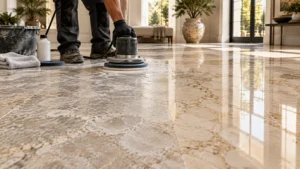
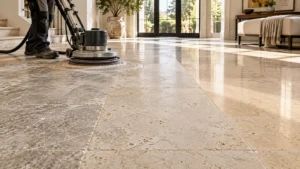
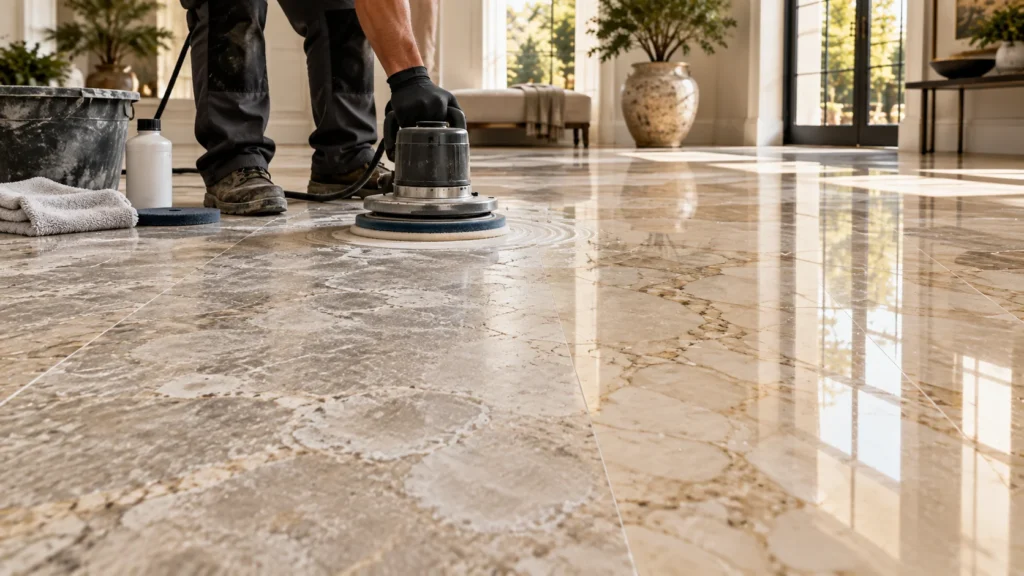
How to deal with etching across a marble floor
A single etch mark and widespread loss of polish require different approaches. When several square metres have been affected by an unsuitable cleaning chemical or years of incorrect maintenance, trying to polish each dull patch individually can leave an inconsistent floor.
Large floors should be assessed as a complete surface. Look for differences between traffic areas and protected areas, check whether the stone contains scratches as well as etching, and establish whether every tile originally had the same level of polish.
Where damage is widespread, a planned honing and polishing sequence usually produces a more consistent result than isolated spot treatment. The surface can be refined evenly before the required level of gloss is recreated across the entire working area.
Edges, corners and doorways should be incorporated into the same process. A highly polished centre with a noticeably dull perimeter can make an otherwise successful restoration look incomplete.
Can marble polishing powder damage the surface?
Any professional restoration product can produce an undesirable result if it is used on the wrong material or applied incorrectly. Marble polishing powders are formulated for compatible carbonate stones and should not automatically be transferred to granite, porcelain, quartz or other surfaces.
The amount of water, working time, machine speed and type of pad can also affect the result. Working one area for significantly longer than another can create differences in gloss, while allowing polishing slurry to dry may leave residue that needs further correction.
This is why test areas are an important part of professional stone restoration. A controlled test demonstrates how the specific marble reacts before the process is repeated across the complete floor.
The existing finish should also be considered. If the marble was intentionally honed or satin-finished, using a high-gloss polishing powder may change the appearance rather than restore it.
Should you polish only the etched area?
Small localised marks can sometimes be restored individually, but blending the repair into the surrounding marble is often more difficult than removing the etch itself. The eye notices differences in reflection very quickly, especially on dark marble or surfaces positioned beneath strong lighting.
Rather than working only inside the exact outline of the etch mark, the treatment may need to be blended over a larger area. On tiled floors, this may mean treating an entire tile or a logical group of tiles so the transition is less noticeable.
The same principle applies to marble worktops. A small etched ring may occupy only a few centimetres, but aggressively polishing that exact spot can create a localised high-gloss patch. Extending the restoration gradually can produce a much more natural match.
Where a floor contains numerous overlapping etches, treating the complete affected zone will generally give a more consistent result than repairing each mark independently.
Will sealing marble prevent future etching?
A marble sealer should not be presented as an anti-etch coating. Most impregnating sealers are designed primarily to reduce the penetration of water or oil-based contaminants into porous material. They can provide valuable stain protection, but they do not normally stop acidic liquids from reacting with the exposed calcium carbonate at the surface.
A sealed marble worktop can therefore still become etched by lemon juice, vinegar or wine. The sealer may help reduce staining from the spill, but the polished surface itself can still lose gloss where the acid makes contact.
After restoration, an appropriate sealer may still form an important part of the protection system. The product should be chosen according to the marble’s porosity, finish and location rather than on the assumption that every marble surface needs the same treatment.
For more information about choosing protection according to the material and required appearance, see the Stone Protection Guide.
How to prevent marble etch marks
Prevention mainly involves controlling acid exposure and responding to spills quickly. Marble used in kitchens, bathrooms, hotels and commercial interiors will inevitably encounter liquids, but many etch marks can be avoided through appropriate maintenance.
Use cleaning products specifically compatible with marble and other acid-sensitive natural stone. Avoid standard vinegar-based cleaners, acidic bathroom products and general-purpose descalers unless the manufacturer clearly confirms compatibility with the particular material.
Food and drink spills should be blotted and cleaned promptly rather than being allowed to remain on the surface. Coasters, trays and mats can provide useful protection in high-risk areas such as bars, vanity tops and kitchen worktops.
Professional cleaners should also know which surfaces they are working on before introducing a chemical product. One incorrect application across a large marble floor can create considerably more restoration work than a single accidental spill.
Common mistakes when trying to remove marble etching
The most damaging mistake is assuming that the mark must still be dirty because cleaning has not removed it. This often leads to stronger chemicals being applied to an already chemically damaged surface.
Another mistake is moving directly to an aggressive diamond grit without first checking whether a polishing-only process would have worked. Removing more marble than necessary increases the number of refinement stages and makes it more difficult to blend a local repair.
The opposite mistake is continuing to polish an area that clearly requires honing. Once a controlled polishing test shows that the damage remains, repeated polishing is unlikely to correct a deeper surface defect.
Failing to assess the marble when completely dry can also produce inaccurate results. Water and slurry temporarily change the appearance of the stone, so every important stage should be cleaned, dried and inspected before deciding whether to continue.
Marble etch mark FAQs
Are marble etch marks permanent?
They are permanent in the sense that normal cleaning will not remove them, but many etch marks can be successfully restored. Light damage may respond to professional polishing, while deeper etching can normally be removed through suitable honing and repolishing where the stone allows.
Can toothpaste remove etch marks from marble?
Household abrasives are difficult to control and may create a patch with a different finish. A professional stone polishing or honing system provides far greater control where matching the surrounding marble matters.
Can a marble etch mark look white?
Yes. Etched polished marble often appears whitish, pale or cloudy because the altered surface scatters light differently. This should not automatically be mistaken for a white stain or mineral deposit.
Can water cause marble etching?
Clean neutral water does not normally etch marble in the same way as an acidic substance. However, mineral deposits, contaminated water or cleaning chemicals used around wet areas can create other surface problems that may appear similar.
Can deep marble etching be repaired?
In many cases, yes. The damaged surface can be progressively honed until the etching has been removed and then refined and polished to restore the required finish. Very severe damage should be assessed professionally before significant material is removed.
Should marble be sealed after etch removal?
Sealing may be appropriate after restoration depending on the marble, location and porosity. The surface should be free from polishing residue and sufficiently dry before a compatible protection product is applied. Sealing helps with stain protection but should not be relied upon to prevent acid etching.
Restore the surface instead of repeatedly cleaning the mark
The most important part of marble etch removal is recognising that the problem is usually damage to the finish rather than dirt sitting on top of the stone. Once an acid has altered polished marble, increasingly aggressive cleaning will not recreate the original surface and can make the affected area considerably worse.
Light etching may only require a controlled polishing process. Deeper marks need to be refined until the damaged layer has been removed, followed by the appropriate honing and polishing stages to rebuild a consistent finish. The correct starting point depends on the depth of the damage, existing finish and type of marble rather than a universal grit sequence.
For professional results, clean and identify the surface first, complete a representative test area and use the least aggressive process capable of removing the defect. Inspect the marble dry between stages and make sure the restored section matches the surrounding surface rather than simply becoming shiny.
AK Surface Solutions supplies professional honing, polishing and stone restoration products for contractors, cleaners and stone-care specialists across the UK. If you are dealing with an unusual marble, widespread etching or are unsure whether polishing or honing should come first, contact AK Surface Solutions with photographs and details of the affected surface for technical product and process advice.