Tile and natural stone restoration can look straightforward from the outside. Clean the floor, polish the surface, apply a sealer and the job is done. In reality, professional restoration is much more technical because different materials react differently to chemicals, abrasives, moisture and mechanical processes. Marble can etch, porcelain can scratch, limestone behaves differently from granite, and even two floors made from the same stone can need different treatment depending on their condition and previous maintenance.
That is why good stone restoration training should teach much more than how to use a machine or apply a product. It should help you understand how to assess a surface, identify the actual problem and choose a process that makes sense. The aim is to build practical judgement, so you know not only what to use, but why you are using it and what result you should expect.
It Starts with Understanding the Surface
Before cleaning, grinding or polishing anything, you need to know what the surface actually is. This sounds obvious, but incorrect surface identification is behind many restoration problems. Natural stones differ in hardness, mineral composition, porosity and sensitivity to chemicals, so a treatment that is safe for one material may damage another. Marble and limestone, for example, are calcium-based stones and can be harmed by acidic products, while granite is generally much harder and behaves differently during polishing.
Manufactured surfaces such as porcelain and ceramic tile introduce another set of considerations. A technician also needs to look beyond the material name and assess the existing finish, previous coatings, sealers, waxes, contamination and wear. A highly polished marble floor should not be approached in the same way as a honed limestone surface, even if both are natural stone. Professional training should therefore begin with surface identification and condition assessment before any product or machine is selected.
Cleaning Is More Technical Than Choosing a Strong Product
Deep cleaning is another area where knowledge matters because a dirty floor does not automatically need the strongest cleaner available. The first question should be what is actually contaminating the surface. General soil, grease, old wax, sealer residue, grout haze, organic staining and mineral deposits all behave differently and may need different chemistry, dwell time or agitation. Using an aggressive cleaner simply because the floor is heavily soiled can create unnecessary problems, especially on sensitive natural stone.
Professional tile and stone restoration training should explain how cleaning products work, why pH matters and when mechanical agitation is useful. It should also cover stripping, because old coatings, topical sealers and maintenance products can interfere with later honing, polishing or sealing stages. The objective is not simply to make a floor look cleaner; it is to prepare the surface correctly for whatever comes next. That distinction is important when moving from routine cleaning into genuine restoration work.
Stain Removal Requires Diagnosis Before Treatment
Stain removal is one of the areas where trial and error can quickly become expensive. A brown mark on a stone floor may be rust, but it could also be organic contamination or moisture-related discolouration, while a dark patch may be oil, water penetration or something that has migrated through a porous surface. These problems cannot all be treated with the same chemical, so diagnosis needs to come before treatment. Good practical training should teach you how to assess the colour, shape and location of a stain and consider how it may have entered the material.
Some contamination sits on the surface, while other staining penetrates deeply and may require extraction methods or repeated treatment. A professional also needs to understand when complete removal is unrealistic, because knowing the limits of a treatment is as important as knowing how to perform it. For more detailed guidance on different stain types and treatment approaches, see the Stone Stain Removal Guide from AK Surface Solutions. Learning to identify first, test second and treat third is one of the most valuable habits in professional surface care.
Honing and Polishing Should Be Taught as a Process
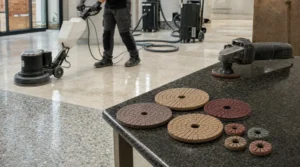
One of the most valuable parts of stone restoration training is learning the difference between honing and polishing. Honing uses abrasives to refine the surface and can remove scratches, wear patterns, etching and other imperfections while progressively improving the finish. Polishing is normally used later to develop clarity, reflection and the final appearance of compatible stone. Trying to polish a badly scratched or uneven surface without completing the required honing stages first will not properly correct the underlying damage.
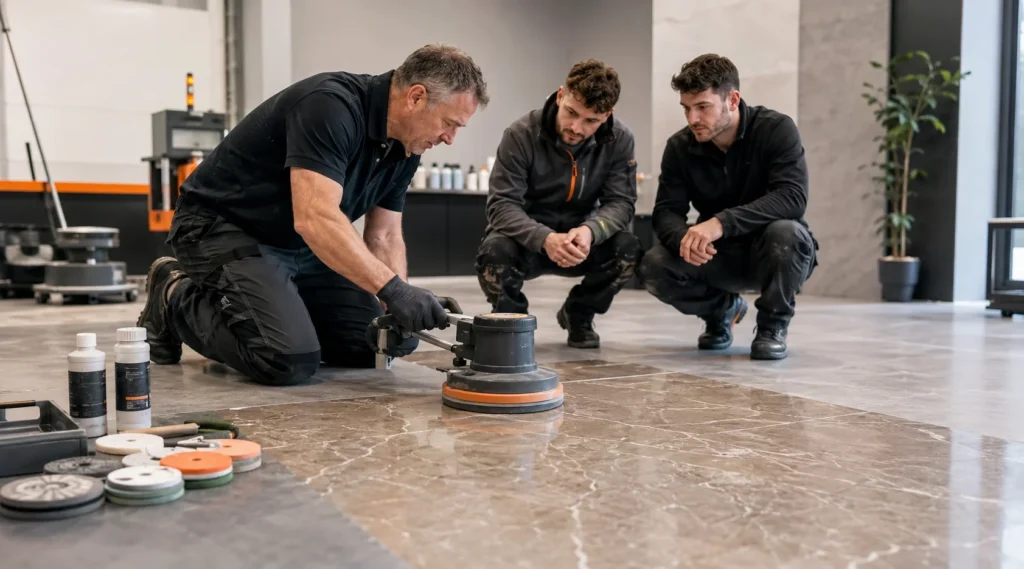
A good course should therefore teach how to assess the condition of a floor before selecting a starting abrasive and how to move through the grit progression logically. Each abrasive stage removes the scratch pattern created by the previous stage, so moving forward too quickly can leave deeper scratches visible once the floor reaches a higher finish. This is difficult to understand fully from videos alone because the visual change from one stage to another is part of the learning. For a deeper explanation of the individual stages, see the Stone Honing & Polishing Guide.
You Need to Understand Why a Finish Has Failed
Restoration is not always about dirt or obvious scratches. Sometimes the bigger question is why a surface no longer looks right in the first place. A marble floor may have lost clarity because of wear, a limestone floor may look patchy after incorrect maintenance, and porcelain may have visible scratches that cleaning cannot remove. A previously sealed floor can also develop uneven colour if the treatment was applied incorrectly or absorbed differently across the surface.
Professional training should help you think diagnostically rather than automatically reaching for a product. The aim is to look at the symptoms, consider the likely cause and work backwards towards the most suitable treatment. That approach reduces unnecessary work and gives you a clearer way to explain the problem to a customer. It also helps prevent the common mistake of treating appearance problems as cleaning problems when the actual issue is finish damage.
Sealing Is Not the Final Step You Apply to Every Stone
One of the biggest misconceptions in stone care is that every natural stone surface automatically needs to be sealed. In practice, some materials are highly absorbent and benefit significantly from an impregnating treatment, while others may absorb very little. The right protection also depends on the location of the surface, its finish and the type of exposure it receives. A kitchen worktop, bathroom floor, external patio and commercial entrance may all require different considerations.
Training should explain the difference between impregnating protection, colour-enhancing products, water repellents and other finishing treatments, but it should also teach preparation. Applying a good sealer to a contaminated, damp or poorly prepared surface can still produce a poor result. Understanding when to seal, what to use and how much product the surface can actually accept is much more useful than simply learning how to apply a sealer. The Stone Protection Guide provides further guidance on matching protection to the material, absorbency and finish required.
Why Hands-On Stone Restoration Training Matters
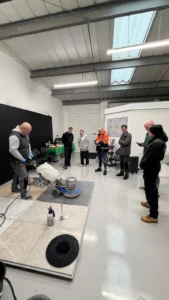
There is a huge amount of information available online about stone care, and that information can be useful for theory and ongoing reference. Restoration, however, is ultimately a practical skill, and watching someone hone marble is not the same as operating the equipment yourself. Reading about polishing compounds also does not show you how a surface should respond during application or how machinery feels when a process is working correctly. Practical training helps connect the theory to what actually happens on the floor.
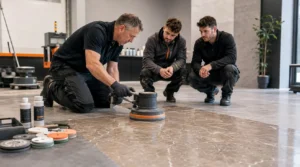
Hands-on work allows you to see how abrasives affect the surface, how the finish changes from stage to stage and how a machine behaves under different conditions. It also gives you the opportunity to ask questions while the process is happening instead of trying to diagnose mistakes afterwards. That confidence becomes especially important once you begin working on customer floors, where errors can be costly and difficult to correct. This is one of the strongest reasons to choose a course that includes real practical participation rather than demonstrations alone.
Who Can Benefit from Tile and Stone Restoration Training?
You do not necessarily need to be completely new to the industry to benefit from professional training. Someone entering the floor restoration trade can use an introductory course to build a structured foundation, while an established cleaning contractor may use it to expand into specialist stone care and hard-floor restoration. Existing restoration professionals can also benefit from refining techniques, testing new products and discussing more difficult surface problems. Businesses may also use practical training to improve the consistency and confidence of employees already working with tile, stone or other hard surfaces.
What matters most is that the training matches your current level of experience. A beginner needs clear fundamentals and practical guidance, while someone already working in the trade is more likely to benefit from deeper technical discussion and troubleshooting. A good course should therefore teach principles that can be applied across different jobs, rather than simply demonstrating one fixed product system. That makes the knowledge more useful once you are dealing with surfaces that do not behave exactly as expected.
What Should You Look for Before Booking a Stone Restoration Course?
Look beyond the course title and read what the training actually includes. A useful professional course should explain why a process is used, not simply demonstrate how to carry it out, and there should be a balance between theory and practical work. You should have the opportunity to work with real surfaces, products, abrasives and equipment rather than spending the entire course watching demonstrations. The course should also include problem solving because real restoration jobs rarely arrive in perfect textbook condition.
Surfaces may contain old treatments, stains, scratches, uneven finishes or previous restoration mistakes, and those are the situations where professional judgement matters most. Before booking, it is also worth checking who the course is designed for, how much hands-on work is included and whether there is time to ask technical questions. Training becomes far more valuable when you leave with a decision-making process rather than a list of products to remember. That is what turns course knowledge into something you can actually use on future jobs.
Hands-On Tile & Stone Restoration Training at AK Surface Solutions
AK Surface Solutions provides a two-day Introduction to Tile & Stone Restoration course in Redditch, Worcestershire. The course is designed to give participants a practical foundation in the complete restoration workflow, including surface identification, cleaning and stripping, stain removal, grinding and honing theory, polishing options, sealing and surface protection. Participants are encouraged to take part in the practical work rather than simply watching demonstrations, so they can see how different processes behave on real surfaces. A certificate is provided after completion of the two-day course.
The next scheduled training session is 14–15 September 2026. It is suitable for people entering the trade, cleaning contractors who want to expand into specialist hard-floor care, restoration professionals who want to strengthen their technical knowledge and businesses looking to train their teams. If you want to understand the process before investing further in equipment, products or a new restoration service, practical training can give you a much stronger foundation. View the upcoming Tile & Stone Restoration Training at AK Surface Solutions and reserve your place.
Frequently Asked Questions
Do I need previous stone restoration experience?
No. Introductory stone restoration training can be suitable for people who are new to the industry, provided the course begins with the fundamentals before moving into practical restoration techniques. It can also be useful for cleaners and contractors who already work with hard floors but want a more structured understanding of stone restoration. Always check the stated course level before booking so you know whether it matches your current experience.
Is stone polishing the same as stone restoration?
No. Polishing is only one part of restoration and is usually used to develop the final level of clarity or gloss on a compatible surface. Depending on the condition of the floor, restoration may also involve deep cleaning, stripping, stain removal, grinding, honing, repairs and protection. The correct process depends on what has actually happened to the surface and what finish is required.
Can I learn stone restoration from online videos?
Online resources can help you understand terminology, products and basic processes, but they cannot fully replicate hands-on experience. Practical training allows you to work directly with surfaces, machinery and restoration systems while receiving guidance as the process develops. The two formats work well together, with online material supporting theory and practical training helping you build confidence in real-world application.
What types of surfaces are covered in stone restoration training?
This depends on the course, but professional training should introduce the differences between common natural stones and manufactured tile surfaces. The aim is to understand why marble, limestone, granite, travertine, porcelain and other materials may need different treatment approaches. A useful course should also teach you to assess the finish and condition of the surface rather than relying only on the material name.
Is stone restoration training useful for professional cleaners?
Yes. Hard-floor and stone restoration can be a valuable specialist service for established cleaning businesses, particularly where customers already require tile, stone or commercial floor care. Training can help cleaners move beyond routine maintenance into more technical services such as honing, polishing, stain treatment and protection. It can also improve confidence when deciding which jobs can be handled in-house and which may require more specialist intervention.
Build Practical Knowledge Before Taking on Restoration Work
Good stone restoration is not about memorising which product goes with which problem. It is about understanding the surface well enough to make the right decision, recognising what has gone wrong and knowing how cleaning, stain removal, honing, polishing and protection fit together. Products and machinery are important, but knowing why and when to use them is what makes the real difference. That practical judgement is what helps reduce guesswork once you are working on actual customer floors.
If you are looking to build those skills through practical instruction, explore the upcoming Tile & Stone Restoration Training at AK Surface Solutions. A good course should leave you with a clearer process for assessing surfaces, selecting treatments and understanding how each stage affects the final result. That foundation is far more valuable than simply learning a few products or techniques in isolation.