Diafil produces professional diamond tools for contractors, stone fabricators and floor restoration specialists working with concrete, terrazzo, marble, granite and other natural stone surfaces.
Two of the most useful ranges are Abralux and Stoneflex. Although both are premium Italian diamond abrasives, they are designed for different applications.
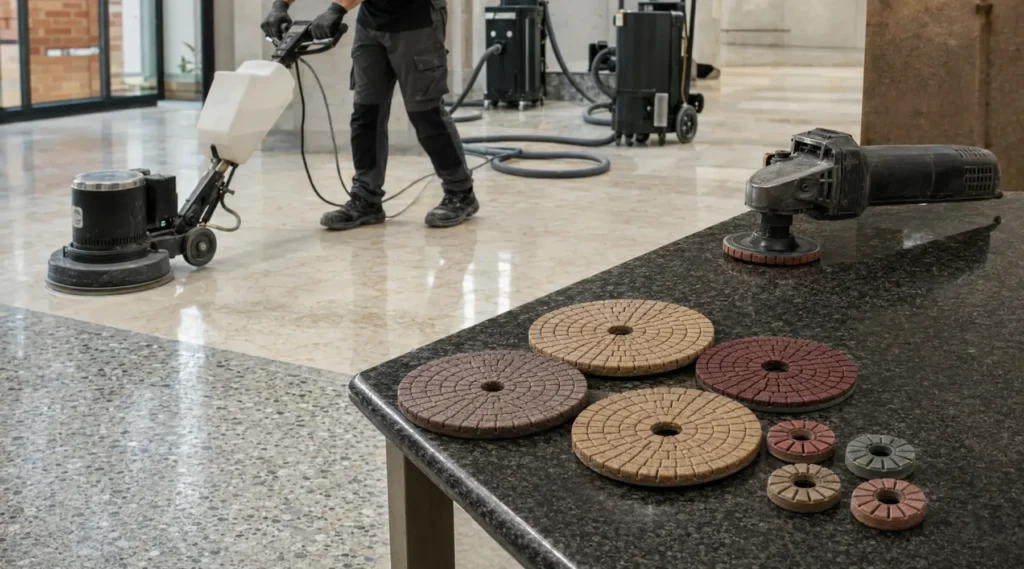
Abralux pads are primarily used for floor grinding, polishing, deep cleaning, laitance removal and restoration. Stoneflex pads are smaller, flexible polishing tools developed for worktops, countertops, vanity tops, edges, profiles and detailed stone fabrication.
Choosing between them depends on the surface being treated, the size and shape of the area, the machine being used and the finish required. This guide explains the main differences and helps professional users select the appropriate Diafil tooling for each job.
What Are Diafil Diamond Tools?
Diafil is an established Italian manufacturer of professional diamond grinding and polishing tools. Its abrasives are used for surface preparation, floor restoration, stone fabrication and polishing across concrete, terrazzo, marble, granite and other hard materials.
The Diafil diamond tools available from AK Surface Solutions include large-diameter Abralux floor pads, smaller Abralux pads, flexible Abralux Rubber Pads, Stoneflex polishing pads, Ultralux Metal Bond tools, El Flex R4 abrasives and specialist hand-polishing products.
A key strength of the Diafil range is the availability of tools for both large floor areas and smaller fabrication or edge-polishing applications.
What Is the Difference Between Abralux and Stoneflex?
The simplest distinction is the type of work each pad is designed to perform.
Abralux pads are commonly selected for professional floor grinding, polishing and restoration. The 17-inch format is suitable for compatible single-disc floor machines and can be used across larger areas of concrete, marble, terrazzo, granite and natural stone.
Stoneflex pads are smaller, flexible resin-bond abrasives designed for stone fabrication and detailed polishing. They are particularly well suited to granite or marble worktops, countertops, vanity tops, edges, profiles, window sills and other areas processed with a handheld polishing machine.
Both ranges contain professional diamond abrasives, but they should not be treated as interchangeable products. Tool diameter, flexibility, bond formulation and the intended machine all influence how a pad performs.
What Are Abralux Diamond Pads?
Abralux 17-inch diamond pads are designed for grinding, polishing, cleaning and maintaining concrete, terrazzo, marble, granite, stoneware, synthetic stone and other suitable hard surfaces.
They can be used for tasks ranging from aggressive grinding and laitance removal to micro-polishing, high-gloss finishing and routine maintenance. Available grit options allow contractors to create a complete progression based on the existing floor condition and the required finish.
Abralux pads differ from many conventional surface-treated diamond pads because of Diafil’s impregnation manufacturing process. The resin and diamond material are carried deeper into the pad instead of being applied only as a light coating on its face.
This construction helps the pad maintain more consistent performance as it wears. It can also provide a longer service life than lightly coated alternatives, although actual pad life will depend on the surface, machine, operating method and maintenance of the tooling.
What Are Abralux Pads Best Used For?
Abralux pads are suitable for a range of professional floor applications.
Concrete Laitance Removal
Laitance is a weak, dusty surface layer that can form on concrete. It may need to be removed before polishing, treatment or the application of another surface system.
Coarser Abralux grits can provide controlled mechanical removal using compatible floor equipment. The correct starting grit should be selected according to the hardness and condition of the concrete.
If the surface requires heavier grinding or levelling, a metal-bond tool may be needed before moving into the Abralux progression.
Concrete Polishing
Abralux pads can be used to refine and polish concrete after the required preparation has been completed. Progressing through the appropriate grits removes the scratch pattern from the previous stage and gradually improves smoothness, clarity and gloss.
The floor should be cleaned thoroughly between grits. Loose abrasive particles or residue from a coarser stage can introduce deeper scratches during subsequent polishing.
Terrazzo and Marble Restoration
Abralux pads are also suitable for grinding, deep cleaning, micro-polishing and restoring terrazzo, marble and other compatible stone floors.
Their range of grits allows contractors to select a starting point based on the amount of wear, staining, scratching or dullness present. A lightly worn floor may only require polishing and gloss-enhancement stages, while a damaged surface may need to begin with a coarser restoration grit.
Natural Stone Floor Polishing
The pads can be used on granite, coloured marble and other suitable natural stone surfaces. The final progression should reflect the type of stone and the required finish.
Not every natural stone responds identically to mechanical polishing. Contractors should test an inconspicuous area before processing the entire floor, particularly when working with an unfamiliar stone or an existing treatment.
Abralux Grit Selection
The required starting grit depends on the floor and the severity of the work. A broadly applicable Abralux progression can be understood as follows:
Coarse grits are used for stronger grinding, laitance removal and correcting more noticeable surface damage.
Medium grits continue refining the scratch pattern and can support deep cleaning and preparation.
Higher grits are used for micro-polishing, improving clarity and developing gloss.
Very fine grits and LUX stages provide final polishing or maintenance on suitable floors.
The correct progression should be determined through inspection and testing. Beginning too aggressively can remove more material than necessary, while starting too fine may polish the surface without removing the underlying scratches or defects.
How Abralux Helps Reduce Orange Peel
Orange peel is an uneven, textured appearance that can remain visible after polishing. It can reduce image clarity and prevent the floor from developing a smooth, consistent reflection.
The deeply impregnated construction of Abralux pads is designed to create a more controlled and even polishing action than abrasives with only a surface-level resin application. When used with the correct machine, grit progression and operating technique, this can help contractors achieve a smoother finish and reduce the risk of orange-peel texture.
However, no pad can compensate for an unsuitable starting grit, incomplete scratch removal or inconsistent machine operation. A high-quality result still depends on completing every necessary stage correctly.
Abralux Pads and Floors with Lippage
Lippage occurs when the edges of adjacent stone tiles sit at different heights. A relatively firm floor pad may make stronger contact with the raised edges than with the lower centres of the tiles.
This uneven contact can create picture framing, where the perimeter of each tile appears different from its centre.
Standard Abralux pads may therefore be less suitable for a badly uneven stone floor. A more flexible tool that follows the surface contours can sometimes provide more consistent contact.
The Abralux Diamond Rubber Pad has a flexible rubber backing developed to adapt more effectively to uneven marble, terrazzo and natural stone floors.
For floors with significant lippage, the surface may need to be mechanically flattened before polishing. Flexible pads can improve contact, but they cannot always correct substantial height differences between tiles.
What Are Stoneflex Diamond Pads?
Stoneflex diamond pads are flexible resin-bond polishing abrasives made for smaller stone surfaces, edges and detailed fabrication work.
Unlike a 17-inch floor pad, Stoneflex pads are used with compatible handheld polishing equipment. Their flexibility allows them to follow edges, profiles and slight contours while maintaining controlled contact with the stone.
Separate formulas are available for different materials because marble and granite do not grind and polish in the same way.
Stoneflex Pads for Granite
Stoneflex Diamond Granite Pads are formulated for the hardness and abrasion resistance of granite.
Granite requires a pad capable of cutting an extremely hard surface while still refining it evenly. The flexible resin bond helps maintain contact across flat areas, edges and profiles, while the diamond matrix provides controlled material removal.
These pads are suitable for granite worktops, kitchen countertops, breakfast bars, vanity tops, fireplaces, staircases, window sills, memorial stone and other hard natural-stone applications.
They can be used wet or dry where the product specification and working environment permit. Wet polishing can help manage heat and dust, while dry processing may be useful for certain on-site applications. Appropriate dust control and personal protective equipment remain essential.
Stoneflex Pads for Marble
Stoneflex Diamond Marble Pads are developed for marble and similar calcium-based stones.
Marble is softer and chemically different from granite, so a granite-specific pad may not deliver the most controlled finish on it. Using a pad formulated for marble can provide more appropriate cutting and polishing behaviour.
Stoneflex Marble pads are suitable for marble worktops, vanity tops, table surfaces, edges, profiles, sills and detailed restoration areas. They may also be used on compatible limestone or travertine when appropriate, but the material should be tested first.
Are Stoneflex Pads Suitable for Worktops?
Stoneflex pads are one of the most appropriate Diafil options for polishing stone worktops, countertops and vanity tops.
The smaller diameter gives the operator greater control than a full-size floor pad. Their flexible structure allows the abrasive to follow edges and slight contours while maintaining a consistent scratch pattern.
A typical progression begins at the grit required to remove the existing damage or fabrication marks. Each following grit should remove the scratches left by the previous pad before the surface moves into the finer polishing stages.
Skipping grits can leave deep scratches underneath an otherwise glossy surface. These scratches often become more visible as the clarity improves.
Abralux vs Stoneflex: Which Should You Choose?
Choose Abralux when working on:
- Concrete, terrazzo, marble or natural stone floors
- Concrete laitance removal
- Floor grinding and surface refinement
- Large-area stone restoration
- Micro-polishing and high-gloss floor finishing
- Compatible single-disc floor machines
Choose Stoneflex when working on:
- Granite or marble worktops
- Kitchen countertops and breakfast bars
- Vanity tops and table surfaces
- Stone edges and profiles
- Window sills, fireplaces and stair components
- Detailed fabrication or on-site repair
- Compatible handheld polishing machines
For an uneven stone floor, consider the flexible Abralux Rubber Pad or another suitable flexible system rather than assuming that a standard floor pad will follow severe lippage.
Where Ultralux Metal Bond Fits into the Process
Some floors require more initial cutting than a resin pad can provide.
Ultralux Metal Bond is a flexible metal-bond diamond abrasive designed for grinding concrete and stone floors with compatible single-disc machines.
It can be used for initial levelling and surface preparation before moving into Abralux diamond pads for refinement and polishing. Its flexible support helps the abrasive maintain contact with natural surface irregularities while providing more substantial material removal than a resin polishing pad.
Using the correct transition between metal and resin stages is important. Moving into a fine Abralux grit before the metal scratches have been sufficiently refined may leave a visible scratch pattern in the finished floor.
Diafil Tools for Irregular and Detailed Surfaces
For surfaces where a conventional round resin pad cannot maintain effective contact, the Diafil El Flex R4 offers a flexible electroplated diamond abrasive.
It can be used for controlled grinding and finishing on flat, curved and irregular areas. Its applications extend across marble, granite, natural stone, concrete, terrazzo, glass, resin and several synthetic materials.
This makes it particularly useful for edge work, defect removal and preparation before finer polishing stages.
Can Diafil Tools Be Ordered with Different Fittings?
Diafil tooling can be supplied with a range of machine fittings on special order. Depending on availability and specification, this may include fittings compatible with professional systems from Klindex, Hyper Grinder, HTC, Husqvarna, Scanmaskin and WerkMaster.
Custom fittings allow contractors to use premium Diafil abrasives with existing grinding and polishing equipment without changing their entire machine system.
Because machines and connection systems vary, the required fitting, tool size, machine model and intended application should be confirmed before placing a special order.
Common Mistakes When Using Diamond Polishing Pads
One common mistake is selecting a pad based only on its grit number. The bond, flexibility, intended material and machine are just as important as the grit.
Another is starting with an abrasive that is too fine to remove the existing damage. Fine pads can improve gloss, but they will not reliably remove deep scratches or flatten an uneven surface.
Contractors should also avoid moving to the next stage before the previous scratch pattern has been removed. Polishing over deeper scratches can make them more visible.
Insufficient cleaning between grits is another source of problems. A single loose particle from an earlier stage can reintroduce deep scratches into a floor or worktop.
Finally, Abralux and Stoneflex should not be used interchangeably simply because both are diamond polishing pads. One is primarily designed for professional floor applications, while the other is designed for smaller stone surfaces and detailed fabrication work.
Need Help Choosing Diafil Diamond Tools?
Selecting the correct tool depends on the material, surface condition, machine, required finish and whether the project involves a floor, worktop, edge or detailed area.
Browse the complete range of Diafil diamond tools, or contact AK Surface Solutions for professional product guidance.
When requesting advice, provide the floor or stone type, approximate area, machine model, current condition and desired finish. This will help the team recommend a more appropriate starting grit, pad type and progression.
Frequently Asked Questions
What makes Abralux diamond pads different?
Abralux pads use an impregnation process that carries resin and diamond material deeper into the pad rather than applying it only to the working surface. This supports consistent performance and a longer usable life than many lightly coated pads.
What are Abralux pads best used for?
Abralux pads are used for concrete and stone floor grinding, laitance removal, deep cleaning, terrazzo restoration, marble polishing, micro-polishing and high-gloss finishing.
Can Abralux pads be used wet or dry?
The standard Abralux range can be used wet or dry according to the product specification and application. The chosen method should also be suitable for the machine, surface and working environment.
Can Abralux pads remove concrete laitance?
Coarser Abralux grits can be used for controlled laitance removal. Heavy laitance, coatings or substantial floor irregularities may require metal-bond grinding before the Abralux stages.
Are Abralux pads suitable for floors with lippage?
Standard Abralux pads may create uneven contact on badly lipped stone floors. The flexible Abralux Diamond Rubber Pad or another suitable flexible system may be more appropriate. Severe lippage may need mechanical flattening.
What are Stoneflex pads used for?
Stoneflex pads are designed for polishing granite or marble worktops, countertops, vanity tops, table surfaces, edges, profiles, window sills and other detailed stone areas.
Should I use granite or marble Stoneflex pads?
Use the formulation intended for the material being polished. Granite and marble have different hardness and polishing characteristics, so material-specific pads provide more controlled performance.
Can Stoneflex pads be used on floors?
Stoneflex pads are primarily intended for smaller stone surfaces, edges and fabrication work with handheld machines. Abralux pads are generally the more suitable Diafil range for large floor areas.
Do I need to use every polishing grit?
Not every project requires the same starting grit, but each selected stage must remove the scratches from the preceding stage. Skipping too far between grits can leave scratches beneath the final polish.
Can Diafil tools fit machines from other manufacturers?
Special-order fittings may be available for systems including Klindex, Hyper Grinder, HTC, Husqvarna, Scanmaskin and WerkMaster. Confirm the exact machine and fitting requirements before ordering.