Concrete densification is an important stage in many professional concrete grinding and polishing systems. When it is carried out correctly, it can improve surface hardness, reduce dusting, increase resistance to abrasion and create a better foundation for the later polishing stages. However, densifier is not a product that should simply be sprayed onto every concrete floor without considering the condition of the slab, the grinding sequence or the finish that needs to be achieved.
For contractors working on polished concrete floors, warehouses, workshops, retail spaces and other commercial environments, understanding when and how to use a concrete densifier can make a noticeable difference to the quality of the finished surface. Applying it too early, using too much product or trying to densify a floor that has not been prepared correctly can create unnecessary residue and inconsistent results.
In this guide, we explain what a concrete densifier does, when it should be introduced into a polishing system, how lithium densifiers work and the common mistakes contractors should avoid when treating concrete floors in the UK.
What is a concrete densifier?
A concrete densifier is a penetrating chemical treatment designed to increase the hardness and density of the upper section of a concrete slab. Unlike many topical sealers or coatings, a densifier is intended to penetrate into the concrete and react with compounds already present within the cement paste rather than forming a thick film on the surface.
Most professional concrete densifiers are based on silicate chemistry. When the silicate penetrates suitable concrete, it reacts with available calcium compounds to create additional calcium silicate hydrate within the pores and capillaries of the surface. Calcium silicate hydrate is one of the materials responsible for the strength of hardened concrete, so increasing its presence can help produce a harder and more abrasion-resistant surface.
This chemical reaction is particularly useful during polished concrete work because the cement paste surrounding the aggregate needs to be sufficiently strong to withstand progressively finer grinding and polishing stages. A weak or dusty surface can be difficult to refine consistently, whereas a properly densified slab generally provides a more stable base for the later stages of the process.
It is important to understand that densification is only one part of the overall concrete finishing system. The result still depends on correct grinding, suitable diamond tooling, proper scratch removal and appropriate protection after polishing.
What does concrete densifier actually do?
The main purpose of a concrete densifier is to harden the cementitious surface of the slab. Concrete naturally contains microscopic pores and capillaries, and the condition of this surface varies considerably depending on the original mix, curing method, finishing technique, age of the slab and amount of traffic it has received.
When a compatible densifier penetrates the floor, its chemical reaction helps fill part of this pore structure with additional cementitious material. The result is a tighter and harder surface that is generally more resistant to abrasion and surface breakdown. This can be especially useful on industrial and commercial floors where constant pedestrian traffic, machinery, pallet movement or cleaning equipment places significant stress on the concrete.
Densification can also help reduce concrete dusting. Dusting occurs when weak material at the surface gradually breaks down and releases fine particles. Where the underlying concrete is otherwise sound, strengthening the upper surface can substantially reduce this problem and make the floor easier to maintain.
For polished concrete, densification has an additional purpose. A harder floor usually responds more consistently to progressively finer diamond tooling, allowing contractors to develop clarity and gloss without repeatedly breaking down a weak cementitious surface.
Concrete densifier vs concrete sealer
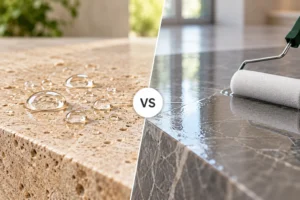
A concrete densifier and a concrete sealer are not the same product, even though the two are sometimes confused. Their functions are different, and they are often used at different stages of a complete concrete finishing system.
A densifier primarily works within the concrete. It penetrates the substrate and reacts chemically to improve the hardness and density of the surface. A sealer, guard or protective treatment is normally used to improve resistance to contaminants such as oils, liquids, staining and general day-to-day exposure.
This distinction is particularly important on polished concrete projects. A contractor may grind the floor, apply densifier and continue polishing, but that does not necessarily mean the finished floor has the level of stain resistance required for its intended environment. In a retail unit, restaurant, warehouse, workshop or commercial interior, an appropriate protective treatment may still be required after the polishing stages have been completed.
AK Surface Solutions therefore treats densification and protection as separate stages within the wider concrete finishing process. Contractors can explore this complete approach in the Concrete Protection Guide and the wider Concrete Protection range.
When should concrete densifier be applied?
There is no universal rule stating that every densifier must be applied after exactly the same grit. The correct point in the grinding sequence depends on the concrete, the desired finish, the tooling system and the instructions provided for the particular densifier being used.
In many polished concrete systems, the initial grinding stages are completed before densification. These early passes remove weak surface material, coatings or contamination where necessary, establish the desired aggregate exposure and begin creating a consistent scratch pattern across the floor. They also help open the concrete so that the densifier can penetrate more effectively.
Once the floor is sufficiently clean, open and receptive, the densifier can be introduced before the finer polishing stages continue. If it is applied while the floor is still heavily contaminated or too tightly closed, the treatment may remain near the surface rather than penetrating as intended.
The key is therefore not simply to follow a grit number without looking at the floor. Contractors should assess how readily the concrete is absorbing liquid, whether the surface has been prepared evenly and whether previous treatments or contaminants could interfere with penetration.
Why surface preparation matters before densifying concrete
Surface preparation has a major influence on the performance of a densifier. Even a high-quality product cannot work correctly if it cannot penetrate the concrete.
Power-floated concrete can be particularly dense at the surface, while existing floors may contain curing compounds, previous sealers, adhesives, oils, paints or years of accumulated contamination. All of these factors can reduce absorption and cause the densifier to behave differently from one section of the floor to another.
Mechanical preparation allows the contractor to remove unwanted surface material and create a more uniform substrate before treatment. The exact grinding method will depend on the hardness of the slab and the condition of the surface. Selecting the correct diamond bond is important because tooling designed for soft concrete can perform very differently when used on hard concrete, and vice versa.
A small test area is often worthwhile before treating a large commercial floor. It allows the contractor to check cutting performance, absorption, scratch removal and the response of the concrete to densification before committing to the complete area.
How to apply a concrete densifier
The exact application method should always follow the manufacturer’s technical instructions, but professional densifier application normally begins with a thoroughly prepared and cleaned concrete surface. Grinding dust and slurry residue must be removed so that the product comes into direct contact with the concrete rather than sitting on a layer of contamination.
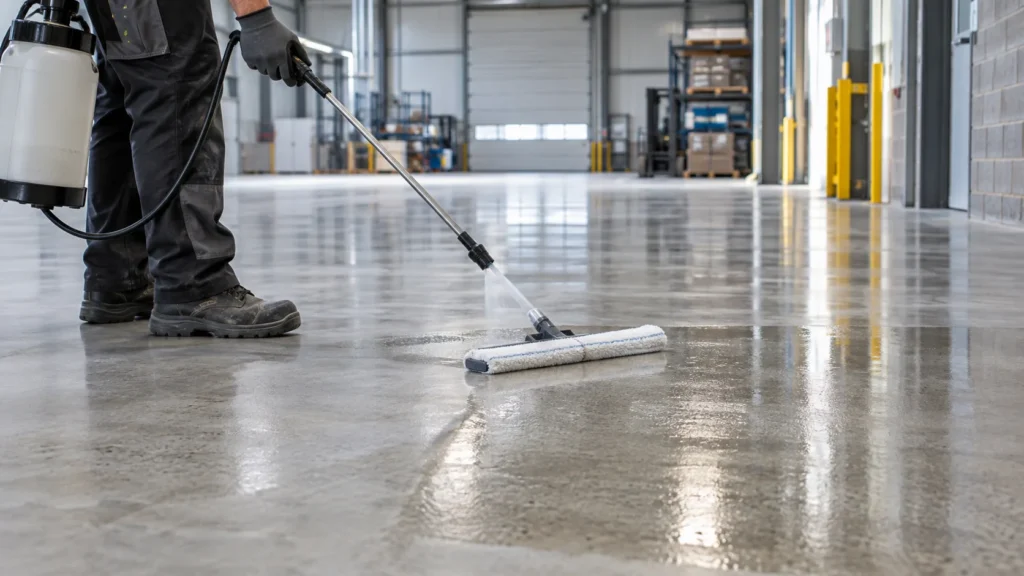
The densifier is then applied evenly across the floor, commonly using a low-pressure sprayer. The material should be distributed consistently rather than being allowed to form deep puddles in certain areas while other sections dry immediately. A microfibre applicator is often used to help spread the product and keep the surface uniformly wet during the required reaction period.
AK Surface Solutions’ ULTRALIT Hard Premium lithium densifier, for example, is applied with a low-pressure sprayer and distributed using a pre-moistened microfibre pad. The surface is kept wet for approximately 10 to 15 minutes to provide sufficient time for penetration before it is allowed to dry.
Once the densifier has reacted and the required drying period has passed, the contractor can continue with the planned grinding or polishing stages. Any unwanted residue should be dealt with before proceeding because dried excess material can interfere with subsequent polishing.
How much concrete densifier should be applied?
Concrete densifier consumption depends heavily on the porosity of the slab. A highly porous or relatively soft floor can absorb considerably more treatment than dense steel-trowelled concrete, so a single coverage figure should never be assumed to apply to every project.
Fresh concrete, power-floated concrete and previously ground concrete can all behave differently. The level of mechanical preparation also changes absorption because grinding exposes a new surface and opens the pore structure of the slab.
With ULTRALIT Hard Premium, expected coverage varies according to the substrate. Fresh concrete may achieve approximately 15 to 25 square metres per litre, while steel-trowelled surfaces may absorb enough product to reduce coverage to approximately 10 to 15 square metres per litre. Honed or polished concrete typically sits within another range depending on how open the floor remains.
These figures should be used for planning rather than as a reason to force a fixed quantity into the floor. If the concrete has stopped absorbing treatment, continuing to apply more product is unlikely to improve the result and can instead leave unnecessary residue on the surface.
Why lithium concrete densifier is popular for polished concrete
Concrete densifiers can use different silicate chemistries, including sodium, potassium and lithium silicates. Each system has its own formulation and performance characteristics, so contractors should evaluate the specific product rather than assuming that every silicate densifier will behave in exactly the same way.
Lithium silicate densifiers are widely used within modern polished concrete systems because their relatively small molecular structure allows them to penetrate cementitious surfaces effectively when the concrete has been prepared correctly. They can therefore integrate well into professional grinding and polishing sequences where controlled penetration and surface hardening are required.
AK Surface Solutions supplies ULTRALIT Hard Premium Concrete Densifier, an 18% lithium-based treatment suitable for new and existing concrete, steel-trowelled surfaces and honed or polished concrete.
For contractors already working with mechanical polishing equipment, the densifier can form part of a complete system that includes initial grinding, progressively finer diamonds, densification, polishing and final protection.
Do you need densifier when polishing concrete?
Densification is commonly included in professional polished concrete systems because grinding and densification perform two different jobs. Mechanical grinding cuts, flattens and refines the concrete, whereas a densifier chemically strengthens the cementitious surface.
A contractor can mechanically grind concrete without using a densifier, but where a durable polished finish is required, densification can make the later polishing stages more predictable. Hardening the surface helps prevent the cement paste from breaking down too easily as finer tooling begins developing clarity and gloss.
This does not mean densifier will correct poor grinding. Deep scratches left by an aggressive metal bond need to be removed by the appropriate transitional stages. Applying densifier over a floor with an inconsistent scratch pattern will simply leave the scratches in a harder surface.
Each stage of the polishing system therefore needs to prepare the floor correctly for the next. Contractors using professional equipment can browse the LAVINA Diamond Tools range to select tooling suited to different concrete hardness levels and polishing stages.
Can concrete densifier be used on old concrete?
Concrete densifiers can be used on many existing concrete floors, provided the substrate is structurally suitable and properly prepared. In fact, older warehouses, workshops and industrial floors are common candidates for grinding and densification because years of traffic may have left the surface dusty, worn or difficult to maintain.
The main challenge with older concrete is determining what has previously been applied to the floor. Sealers, coatings, paint, oil, adhesives and curing products may prevent a penetrating densifier from reaching the cement paste underneath. These materials may therefore need to be removed mechanically before treatment begins.
Contractors should also distinguish between normal surface wear and more serious concrete failure. Densifier can improve the performance of a sound but porous or dusty surface, but it is not a repair solution for major cracking, structural movement, delamination or severely deteriorated concrete.
Where there is uncertainty, a test section allows both the preparation method and densifier absorption to be assessed before the complete floor is treated.
Will concrete densifier stop concrete dusting?
One of the most common reasons for using a densifier on industrial floors is to reduce surface dusting. Weak cement paste gradually breaks down under traffic, producing fine particles that can spread through warehouses, workshops and production areas.
By chemically hardening the upper surface of suitable concrete, a densifier can substantially reduce this type of wear. This can improve housekeeping and reduce the amount of loose concrete dust generated by routine vehicle or pedestrian movement.
However, contractors should investigate the reason the floor is dusting before treatment. A slightly weak but otherwise sound surface is a very different problem from concrete affected by severe deterioration, moisture issues or an unsuitable original mix.
Densifier works best when it is being used for the problem it was designed to solve. It should not be treated as a universal repair product for every type of damaged concrete.
Common mistakes when applying concrete densifier
One of the most common mistakes is applying densifier before the concrete has been properly prepared. If a floor is still sealed, contaminated or extremely closed, the treatment may have difficulty penetrating and can remain on the surface instead.
Uneven application is another frequent problem. One part of the floor may absorb the material immediately while another remains saturated. Contractors need to monitor the floor as the product is being applied and redistribute material where required rather than simply spraying the same quantity across every square metre.
Using excessive densifier is also unnecessary. Once the concrete has absorbed the amount it can accept, additional product may begin drying on the surface and create residue that needs to be removed before polishing continues.
Another mistake is expecting densifier to replace the final protection stage. Although it can improve surface hardness and reduce dusting, a separate protective guard may still be needed where resistance to spills, staining and general contamination is important.
Concrete densifier for warehouses and industrial floors
Industrial concrete floors experience very different demands from domestic concrete. Forklifts, pallet trucks, machinery, storage systems and constant traffic can gradually wear away the upper surface, particularly where the original concrete is relatively soft or dusty.
Densification can be useful in these environments because it strengthens the existing cementitious surface without creating a thick coating that is expected to perform like a resin system. For facilities where the appearance of the floor is secondary to durability and ease of maintenance, a mechanically prepared and densified concrete floor can provide a practical solution.
Warehouses may also benefit from further refinement after densification. Depending on the specification, the floor can be honed or polished to create a smoother surface that is easier to clean and reflects more available light.
Where additional resistance to stains and contaminants is required, the densified floor can then be combined with a compatible concrete protection system.
Using densifier on polished concrete floors
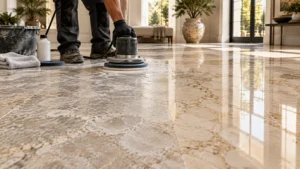
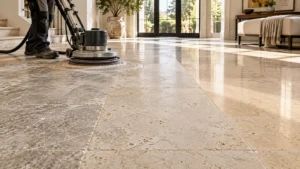
A polished concrete floor is created through a sequence of mechanical processes rather than by applying a single product that creates shine. The contractor first determines how much surface material needs to be removed and what level of aggregate exposure is required. The floor is then ground progressively to create an increasingly refined scratch pattern.
Once the surface has reached the appropriate stage, densifier can be introduced to strengthen the cement paste before finer polishing continues. The subsequent diamond stages refine the floor further until the required clarity and gloss have been achieved.
The final appearance depends on both the starting concrete and the chosen specification. Some projects require a relatively natural honed appearance, while retail environments and architectural interiors may require a much higher degree of refinement.
For contractors planning a complete concrete finishing system, the AK Surface Solutions Concrete Protection Guide explains how preparation, densification, polishing and protection work together.
How to choose the right concrete densifier
Choosing a concrete densifier should begin with the floor rather than the product label. Contractors should consider the age of the concrete, surface hardness, porosity, finishing method, previous coatings and the required final appearance before deciding how the floor should be treated.
The intended use of the building also matters. A warehouse where the priority is reducing dust and improving surface durability has different requirements from a polished concrete showroom where gloss, clarity and stain resistance all need to be considered.
It is also important to look at the densifier as one part of the complete system. The grinding machine, diamond bond, grit progression, cleaning method and final protection products should all be compatible with the intended result.
Technical support can therefore be particularly valuable on unusual slabs. If a floor is behaving differently from expected, changing the tooling or preparation sequence may be more effective than simply applying additional chemical treatment.
Does concrete densifier make concrete waterproof?
Concrete densifier should not be treated as a waterproofing product. Its primary purpose is to harden and densify the cementitious surface by reacting within the concrete.
The treated surface may become less porous as part of the densification process, but this does not mean the floor has been waterproofed or given the same resistance to liquids as a specialist membrane, coating or protective treatment.
Where a project has specific requirements relating to water ingress, chemical exposure or stain resistance, the appropriate protection system should be specified separately.
This is particularly important when explaining a polished concrete system to the end client. Densification, polishing and protection all contribute different properties to the finished floor.
How long does concrete densifier take to work?
The reaction time for a concrete densifier varies according to the formulation, floor condition and environmental conditions. Contractors should therefore follow the technical instructions supplied with the product rather than applying generic timings to every system.
ULTRALIT Hard Premium is kept wet on the surface for approximately 10 to 15 minutes during application to allow sufficient penetration. Once the surface has dried, work can continue according to the recommended process, while the chemical hardening reaction continues developing over time.
Temperature, airflow and concrete porosity can all influence how quickly the product appears to dry. On a porous surface, densifier may be absorbed rapidly, while a denser slab may keep the treatment visible for considerably longer.
The application should therefore be monitored continuously rather than being treated as a simple spray-and-leave process.
Should concrete be sealed after applying densifier?
Whether additional protection is required depends on how the floor will be used. Densification improves surface hardness, but it does not automatically provide all the stain or contaminant resistance required in a commercial environment.
A polished concrete floor in a retail unit, reception area or showroom may therefore receive a suitable guard after polishing has been completed. Industrial floors can also benefit from protection where oils, liquids or other substances are likely to come into contact with the concrete.
The final treatment should be selected according to the required appearance and level of protection. Matt and gloss systems can produce very different results even when the underlying concrete has been prepared in the same way.
AK Surface Solutions supplies a range of professional Concrete Protection Products that can be incorporated into complete grinding, densifying, polishing and protection systems.
Concrete densifier FAQs
When should concrete densifier be applied during polishing?
Densifier is commonly applied after the initial grinding stages have opened and prepared the concrete but before the later polishing stages. The exact point should be selected according to the slab, the polishing specification and the product instructions.
Can densifier be applied to existing concrete?
Yes. Many professional densifiers are suitable for existing concrete provided previous coatings, contamination and other materials that could prevent penetration have been properly removed.
Does concrete densifier change the colour of concrete?
A clear penetrating densifier is not intended to colour concrete in the same way as a stain or coating. However, concrete surfaces vary considerably, so completing a small test area is sensible where the finished appearance is particularly important.
Is lithium densifier suitable for industrial floors?
Lithium silicate densifiers are commonly used on commercial and industrial concrete, including warehouse floors, workshops and polished concrete installations. The individual product should still be checked for compatibility with the substrate and intended application.
Can you polish concrete without densifier?
Concrete can be mechanically ground and polished without chemical densification, but densifier is commonly incorporated into professional polishing systems because it can improve the hardness and stability of the cementitious surface.
Does densifier replace concrete sealer?
No. Densifier primarily improves the hardness and density of concrete, while a sealer or protective guard may be used to provide additional resistance to staining and contamination.
How many coats of concrete densifier are required?
The required amount depends on the formulation and the absorption of the concrete. Rather than automatically applying multiple coats, contractors should follow the specified coverage and application method for the chosen densifier.
Build the concrete system around the condition of the floor
Good polished concrete results rarely come from choosing one product in isolation. The condition and hardness of the concrete, the grinding machine, diamond bond, grit progression, densification stage and final protection system all affect the finished surface.
For contractors, the most reliable approach is to assess the slab before deciding on the complete process. Once the concrete has been correctly prepared, a suitable lithium densifier can increase surface hardness, reduce dusting and create a better foundation for subsequent polishing. The floor can then be refined and protected according to the requirements of the building.
AK Surface Solutions supplies professional concrete densifiers, LAVINA grinding equipment, diamond tooling and concrete protection products for contractors throughout the UK. If you are unsure which densifier, tooling combination or protection system is suitable for a particular project, contact AK Surface Solutions with details of the floor, its current condition and the finish you need to achieve.