Choosing a professional floor grinder is not simply a matter of selecting the largest or most powerful machine available. The right choice depends on the type of floors you work on, the size of your projects, the material you need to remove, the finish you want to create and the power supply available on site.
A suitable grinder can be used for concrete preparation, surface flattening, paint and coating removal, aggregate exposure, terrazzo restoration and polished concrete systems. However, the machine is only one part of the process. The final result also depends on the diamond tooling, dust extraction and working sequence used with it.
This guide explains how to choose a floor grinder, when a planetary machine is required and how to match the grinder and tooling to professional concrete and hard-floor work.
You can also browse our range of professional floor grinding and polishing machines.
What Is a Professional Floor Grinder?
A professional floor grinder is designed to mechanically cut, flatten and refine hard floor surfaces. It can be used on concrete, terrazzo, natural stone and other compatible materials when fitted with the correct tools.
The machine provides the weight, movement and power, while the attached diamonds or scraping tools perform the actual surface removal. This means one planetary grinder can complete several different jobs simply by changing the tooling.
For example, an aggressive PCD tool may be fitted when a thick coating needs to be removed. Metal bond diamonds may then be used to flatten the concrete and refine the surface. Transition tools and resin pads can be added later if the floor is being taken through a full polishing system.
A grinder may therefore be used for surface laitance removal, adhesive removal, high-spot correction, aggregate exposure, coating removal and final polished concrete preparation.
Why Planetary Grinders Are Used for Concrete Work
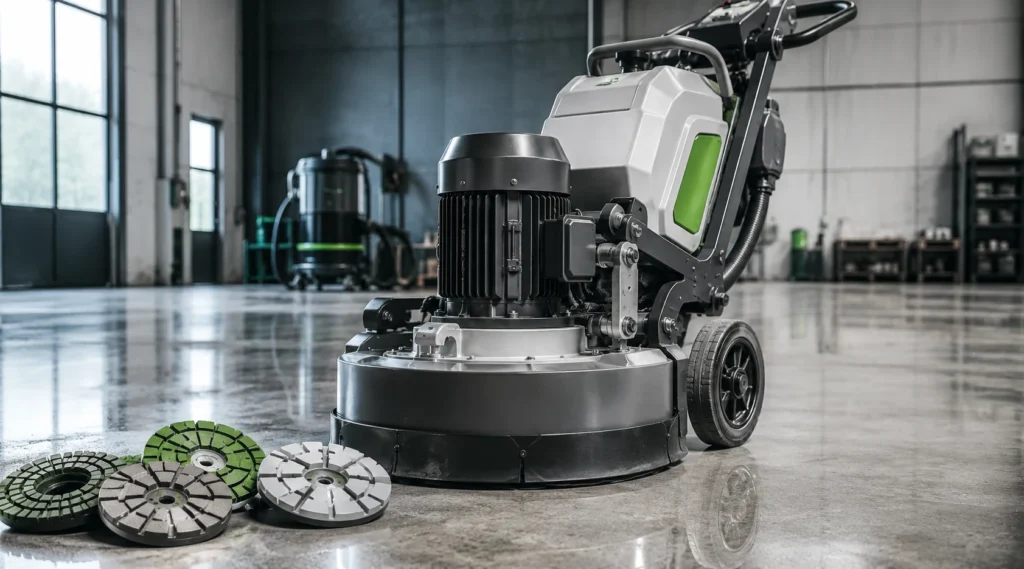
A planetary grinder uses several smaller rotating heads within a larger rotating system. This combined movement helps distribute the cutting action across the floor more evenly.
For professional concrete preparation, this provides better control than a basic single-disc machine. It can produce a more consistent scratch pattern, reduce visible circular marks and help the operator maintain an even cut across larger areas.
This becomes especially important during concrete polishing. The surface must be refined gradually through each stage. A floor can appear shiny at the end of the process while still showing deep scratches, uneven aggregate exposure or cloudy areas beneath the reflection.
A planetary grinder helps create a more controlled foundation for the later polishing stages. The machine does not create a successful finish on its own, but it makes it easier to maintain consistency when the correct tools and working sequence are used.
Floor Grinder or Rotary Machine?
A floor grinder and a rotary machine perform different jobs.
A planetary grinder is required when the floor needs to be cut, levelled or mechanically refined. It is the correct type of machine for flattening concrete, exposing aggregate, removing high spots and completing a full polished concrete process.
A rotary machine is more appropriate for cleaning, buffing, maintenance and some finishing applications. It can be useful for working cleaning chemicals, applying certain finishing products or burnishing a completed floor.
However, a rotary machine does not normally have the weight, tooling system or planetary movement required to replace a professional grinder. It may support the final stages of a floor-care system, but it should not be treated as an alternative when the concrete itself needs to be mechanically corrected.
Choose the Grinder Around the Work You Actually Do
The best machine is the one that suits the projects you complete regularly.
A wider grinder may provide higher productivity on large commercial floors, but that advantage can be lost if the machine is difficult to transport or cannot pass through the available access points. A more compact machine may take longer on a large warehouse floor, but it can be far more practical for residential projects, shops and medium-sized commercial spaces.
Before choosing a model, consider the average size of your floors, not only the largest project you hope to complete. Access, transport, available labour and power supply should be considered alongside grinding width and output.
Contractors who regularly work in houses, smaller commercial properties and restricted-access areas may benefit from a compact professional machine. Contractors who mainly work on larger open floors may need a wider grinder capable of covering more surface area during each pass.
LAVINA L20S7 and L20OS7
The LAVINA L20S7 and L20OS7 are compact professional grinders suited to smaller and medium-sized projects.
They can be used for concrete preparation, polishing and restoration work where access and manoeuvrability are important. This makes the L20 range relevant for residential floors, shops, smaller commercial areas and projects where the machine must be moved frequently between sites.
A compact grinder does not mean that the machine is limited to light-duty work. With the correct tooling, it can still be used for coating removal, surface preparation, aggregate exposure and polished concrete systems.
The main advantage is that the machine offers professional grinding capability in a size that is easier to control and transport than a wider commercial grinder.
You can review the LAVINA L20S7 and L20OS7 floor grinder for further product details.
LAVINA L25S7 and L25LS7
The LAVINA L25S7 and L25LS7 are better suited to contractors who frequently work on larger floors and need greater productivity.
The wider grinding path allows the machine to cover more surface area during each pass. This can reduce working time on commercial, warehouse and industrial projects where there is enough open space for a larger machine to operate efficiently.
The L25 range may also be more suitable for contractors completing regular concrete preparation and polishing work rather than occasional smaller projects.
The wider machine is not automatically the better choice for every business. It requires suitable transport, access and power. Contractors should compare their usual project sizes with the practical demands of moving and operating the machine.
Both the L20 and L25 ranges can be viewed through the floor grinding and polishing machines category.
Confirm the Available Power Supply
Power requirements should be checked before a grinder is ordered.
The machine must be compatible with the electrical supply normally available on site. Voltage, phase, amperage and cable requirements all need to be confirmed. The dust extractor must also be included in the calculation because it will usually operate at the same time as the grinder.
A higher-output grinder may not be practical if the required supply is rarely available on the sites where you work. Power limitations can lead to delays, generator costs or difficulty operating the complete grinding and extraction system safely.
It is therefore important to choose a grinder that matches both the intended workload and the type of power supply you can reliably access.
The Tooling Determines What the Grinder Can Do
The same machine can perform very different jobs depending on the tools fitted beneath it.
Metal bond diamonds are normally used for the early grinding stages. PCD tools and carbide scrapers are used when coatings, paint or adhesive need to be removed. Transition tools help refine scratches left by metal diamonds, while copper, hybrid and resin pads are used during the later stages of polishing.
A machine fitted with the wrong tool may cut very slowly, wear the diamonds too quickly or leave scratches that are difficult to remove later.
The tooling should be selected according to the floor condition, the material being removed and the final finish required. Browse our LAVINA diamond tools for compatible grinding, coating-removal and polishing options.
Choosing Tools for Paint and Coating Removal
Paint and coating removal should begin with an assessment of the material on the floor.
A thin coating or paint layer may respond well to carbide scrapers or PCD tools with scarifying bars. These tools can remove surface material while also beginning to prepare the concrete beneath it.
Thicker or strongly bonded coatings may require more aggressive PCD tools without scarifying bars. These are intended to remove heavier build-up more efficiently, but they must be used carefully because an aggressive tool can leave deep marks in the concrete.
Metal bond diamonds may be more suitable when the job involves light adhesive residue, surface laitance or general concrete preparation rather than a heavy coating.
The most aggressive option is not always the best one. If the underlying floor is damaged unnecessarily, additional grinding stages may be required before the surface is ready for polishing or another finish.
Choosing Metal Bond Diamonds for Concrete Hardness
Concrete hardness has a direct effect on diamond-tool performance.
Soft concrete is more abrasive and normally requires a harder bond. The harder matrix holds the diamond particles for longer and reduces excessive tool wear.
Hard concrete normally requires a softer bond. The softer matrix wears away more readily, allowing fresh diamonds to remain exposed and continue cutting the dense surface.
Medium concrete generally needs a balanced bond that provides steady cutting without glazing or wearing away too quickly.
Using the wrong bond can significantly reduce productivity. A tool that is too hard for the floor may glaze and stop cutting. A bond that is too soft may wear rapidly and increase tooling costs without producing a better result.
When the hardness is uncertain, a controlled test area should be completed before a complete tooling set is selected.
Why Scratch Refinement Matters
Every grinding tool leaves a scratch pattern.
The next stage must remove the scratches left by the previous stage before the operator moves to a finer grit. If the process advances too quickly, deep scratches can remain beneath the later polishing stages.
These scratches may become especially visible when light reflects across the finished floor.
A typical polished concrete system begins with metal grinding and surface correction. Cracks and defects may then be repaired before the scratch pattern is refined further. Transition or hybrid tools are used to bridge the gap between metal diamonds and resin polishing pads.
The resin stages then develop surface clarity and reflectivity. A densifier and protective treatment may also form part of the system depending on the concrete and required finish.
The exact sequence should be based on the performance of the current stage rather than following a fixed number of passes without inspecting the surface.
For guidance on densifiers, guards and ongoing maintenance, read our Concrete Protection Guide.
Transition Tools, Copper Pads and Resin Polishing
Metal bond diamonds are effective for cutting and flattening, but they leave a deeper scratch pattern than later polishing tools.
Transition tools are used to refine this scratch pattern before the resin stages begin. Without a suitable transition, the operator may spend too long trying to remove metal scratches with tools that are too fine.
Copper or hybrid pads may also be used during intermediate refinement. They can help create a smoother progression between aggressive grinding and final polishing.
Resin pads are then used to develop clarity, reflectivity and gloss through progressively finer stages.
The final finish should result from proper mechanical refinement. A guard or finishing product may improve stain resistance and enhance the appearance, but it cannot hide an incomplete grinding sequence.
Can the Same Grinder Be Used for Terrazzo and Stone?
LAVINA grinders can be used for terrazzo and some natural-stone restoration work when fitted with suitable tooling.
The machine should not be used on every material with the same concrete-grinding tools. Terrazzo, marble and other stone surfaces require more careful abrasive selection and process control.
The operator must consider the existing finish, the depth of scratches, the hardness of the material and the appearance required at the end of the restoration.
A test area is especially important when a concrete grinder is being used for stone or terrazzo. The goal is to remove the damage without creating unnecessary scratches or uneven areas.
For material-specific restoration guidance, refer to our Stone Honing and Polishing Guide.
Do Not Ignore Dust Extraction
Dust extraction is a core part of a professional grinding system.
Dry concrete grinding can create a significant amount of airborne dust. A suitable industrial extractor improves visibility, helps the tools cut more effectively and reduces dust spreading across the site.
The extractor must have enough airflow and capacity for the grinder being used. Hose size, separator capacity, filter condition and available power can all affect performance.
An undersized extractor can reduce productivity and make the working environment harder to control. The grinder and extractor should therefore be selected as a compatible system rather than treated as separate purchases.
Questions to Consider Before Buying
Before choosing a grinder, confirm the type of work it will complete most frequently.
Consider the typical floor size, whether you mainly prepare or polish concrete, the coatings you normally remove and the access available on site. You should also know which power supply and dust extractor will be used.
Transport is another important factor. A machine that performs well on the floor must still be moved safely between projects.
It is also worth considering whether the grinder will be used only for concrete or whether terrazzo and stone restoration will form part of your services.
These factors will help determine whether a compact L20 model or wider L25 machine is the more practical investment.
Common Floor-Grinder Buying Mistakes
One common mistake is choosing a machine only by grinding width. A wider path can improve output, but only when the machine suits the sites and projects being completed.
Another mistake is overlooking the cost and availability of tooling. The grinder cannot complete professional work without metal bonds, coating-removal tools, transitions and polishing pads.
Some buyers also fail to check the site power supply or assume that a rotary machine can replace a grinder. These issues can prevent the equipment from completing the work it was purchased for.
Dust extraction should not be left until the end of the buying process. The grinder, extractor, hoses and power requirements need to be considered together.
Should You Choose the L20 or L25?
The L20 range is likely to be the better option where manoeuvrability, transport and smaller-to-medium project sizes are the main priorities.
The L25 range is better suited to contractors who frequently complete larger commercial floors and need greater productivity from a wider grinding path.
The correct decision depends on the work your business completes most often. Neither machine is automatically better for every contractor.
Get Help Choosing a Floor Grinder
A floor grinder should be selected as part of a complete system that includes compatible tooling and dust extraction.
AK Surface Solutions can help you choose equipment for concrete preparation, surface flattening, coating removal, terrazzo restoration and polished concrete systems.
Before ordering, provide information about your typical project size, available power supply, access, floor condition and the work you expect the machine to perform.
Browse our professional floor grinding machines, view compatible LAVINA diamond tooling or contact AK Surface Solutions for practical advice.
Floor Grinder FAQs
Do I need a floor grinder or a rotary machine?
You need a floor grinder when the surface must be mechanically cut, flattened or refined. A rotary machine is more suitable for cleaning, buffing and light finishing work.
Can a planetary grinder remove paint and coatings?
Yes. The result depends on fitting the correct carbide scraper, PCD tool or metal bond diamond for the coating type and floor condition.
Which grinder is better for residential projects?
A compact professional model such as the LAVINA L20S7 or L20OS7 may be more practical where transport, access and manoeuvrability are important.
Which machine is better for large commercial floors?
The LAVINA L25S7 or L25LS7 is better suited to larger areas where a wider grinding path and higher productivity are required.
Can the same grinder polish concrete and restore terrazzo?
Yes, when it is fitted with the correct tools and used with a suitable process for the material. Concrete, terrazzo and natural stone should not all be treated with the same abrasive sequence.
Can AK Surface Solutions help select the machine and tools?
Yes. Contact AK Surface Solutions with information about your floor type, project size, coating, available power and required finish so the machine and tooling can be matched to the work.